Published on
Why the wholesale ecommerce market is becoming more challenging in 2026 (and how brands can navigate it)
Contributors

Orderchamp
5 min read

In this article
The wholesale ecommerce market is evolving at a pace we haven’t seen before, and for many brands, keeping up is becoming a real challenge.
Not long ago, B2B wholesale followed a relatively predictable rhythm. Seasonal buying cycles, stable pricing, and consistent demand created a sense of structure that brands could rely on. Today, that landscape looks very different. What used to be steady and familiar is now more fragmented, fast-moving, and increasingly competitive.
Brands are no longer navigating a single channel or a straightforward sales process. Instead, they’re facing pressure from multiple directions at once. Global ecommerce platforms are driving pricing competition, retailer buying behavior is shifting, sales channels are multiplying, and operational demands are growing more complex by the day.
All of this is reshaping what it means to succeed in wholesale.
For brands and wholesalers, adapting to this new reality isn’t optional, it’s essential. The strategies that worked a few years ago are no longer enough. To stay competitive and build a wholesale model that can truly scale in 2026 and beyond, it starts with understanding what’s changing and why it matters.
Global ecommerce giants are resetting price expectations
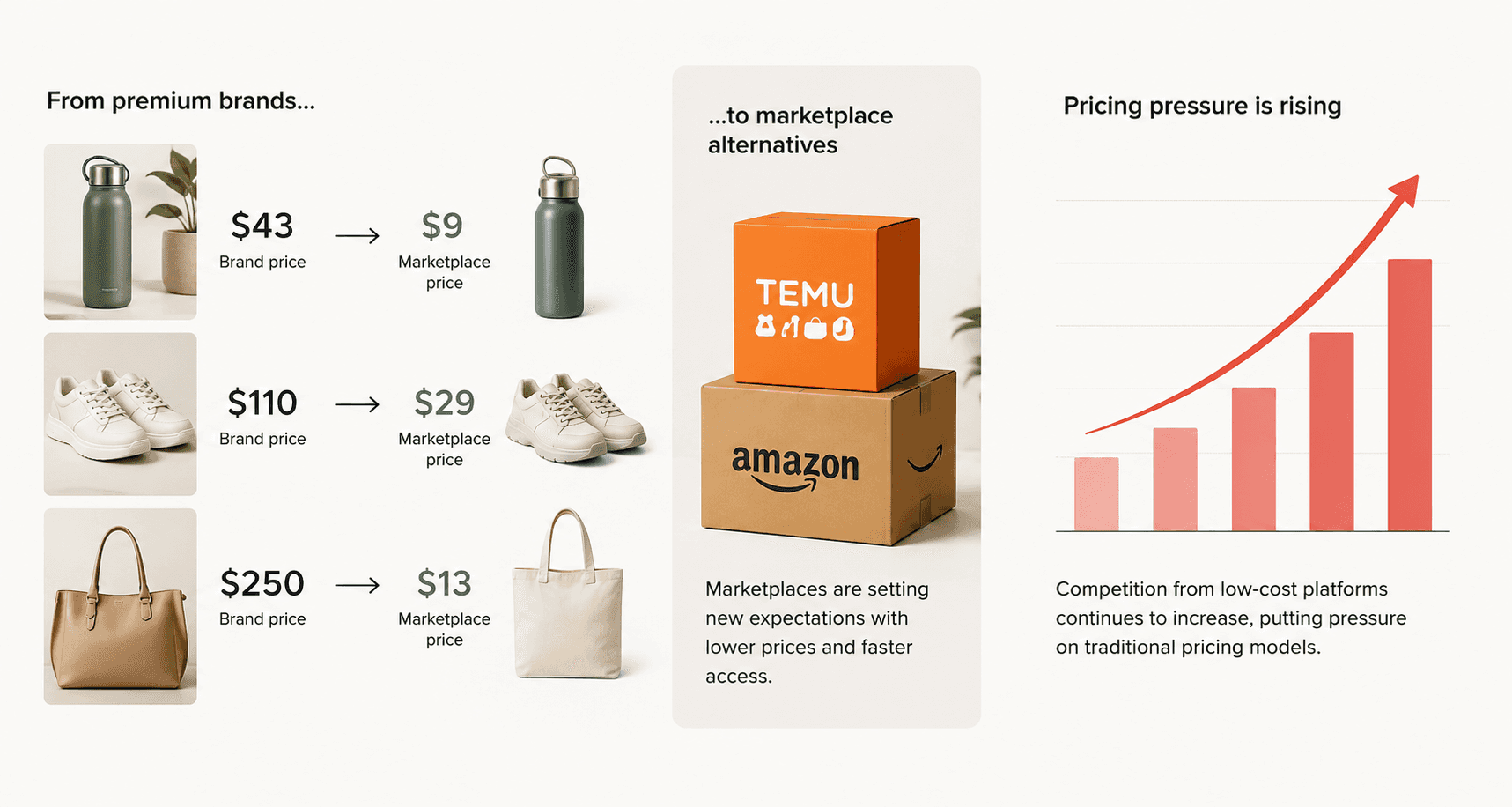
One of the most disruptive forces in today’s wholesale market is the rise of global ecommerce platforms such as Amazon and Temu. While these platforms are often seen as competitors for consumers, their impact goes far beyond that. They are actively reshaping price expectations across the entire retail landscape.
Where pricing used to be more stable and easier to justify, both consumers and retailers now have instant access to countless alternatives online, often at significantly lower price points. This shift is changing how products are evaluated and compared, making pricing conversations more challenging for brands.
It’s no longer uncommon for retailers to directly question pricing in a way that reflects this new reality:
“Why is your product €40 when something similar is €15 online?”
This growing comparison culture is forcing wholesale brands to rethink not just their pricing, but also how they communicate value.
This shift is reinforced by the scale at which these platforms operate.
According to Amazon, the company has invested more than €215 billion in Europe since 2010, including logistics infrastructure, data centers, and operations.
At the same time, Temu is actively expanding its European logistics footprint, with reports indicating a move toward local warehouse fulfillment to reduce delivery times and increase competitiveness.
This is why building a story around their product is becoming increasingly important for brands.
Competing on price alone is no longer a sustainable strategy for most wholesale businesses. Instead, the brands that stand out are those that clearly communicate their value through a compelling story. Whether it’s design, materials, origin, or mission, these elements give retailers a stronger reason to choose a product beyond simple price comparison.
A strong product story changes the conversation. It moves away from “Why is this more expensive?” and toward “Why does this product deserve a place in my store?”
As retailers and consumers become more familiar with a brand and its positioning, that value becomes easier to understand, and pricing becomes easier to justify.
Many successful brands have already embraced this shift. When we asked five brands on the Orderchamp Marketplace whether pricing or brand story matters more today, all of them highlighted storytelling, or a strong combination of both, as the key driver of success.
Retailers are de-risking inventory and buying less upfront
A major shift is happening on the retailer side. Retailers are becoming far more cautious about how they buy inventory. Instead of placing large orders months in advance, they are increasingly ordering smaller quantities, waiting longer before committing, and reordering during the season. This shift is driven by risk management. In uncertain economic conditions, holding large amounts of unsold inventory becomes financially risky.
For brands, this creates a structural mismatch. Instead of managing a few large wholesale orders, they now handle many smaller ones, increasing complexity and making it significantly harder to plan inventory accurately. As a result, maintaining the right stock levels is becoming one of the biggest operational challenges.
As Jill from Lepelclub explains:
“The most challenging part… I would say always having the right stock levels… but also thinking about newness—what are we going to launch next?”
For growing brands, this challenge becomes even more visible. Increased demand is positive but harder to forecast and manage in a more fragmented buying landscape.
As Ilse from LOT83 summarizes their biggest challenge:
“The growth, and with that, keeping the stock levels up… there is just a lot of demand for our items. So that always remains a challenge. But a good challenge.”
This shift is pushing brands to become more flexible in how they operate—managing stock more dynamically, enabling faster reorders, and responding to demand in real time.
At the same time, strong retailer relationships are becoming more important. Retailers expect brands to think along with them, communicate clearly, and support their success, highlighting what really makes retailers buy from wholesale suppliers in today’s market.
Flexibility is no longer a differentiator—it’s becoming the standard.
Sales channels are starting to compete instead of complement
Another growing challenge is the increasing complexity of managing multiple sales channels. Brands today operate across trade shows, showrooms, marketplaces, and digital ordering environments. While this creates more opportunities, it also introduces channel conflict.
Retailers may hesitate to order at a trade show if they expect better pricing online. Sales agents may feel bypassed when retailers order directly through a portal. Inconsistent pricing or assortments can create confusion and reduce trust.
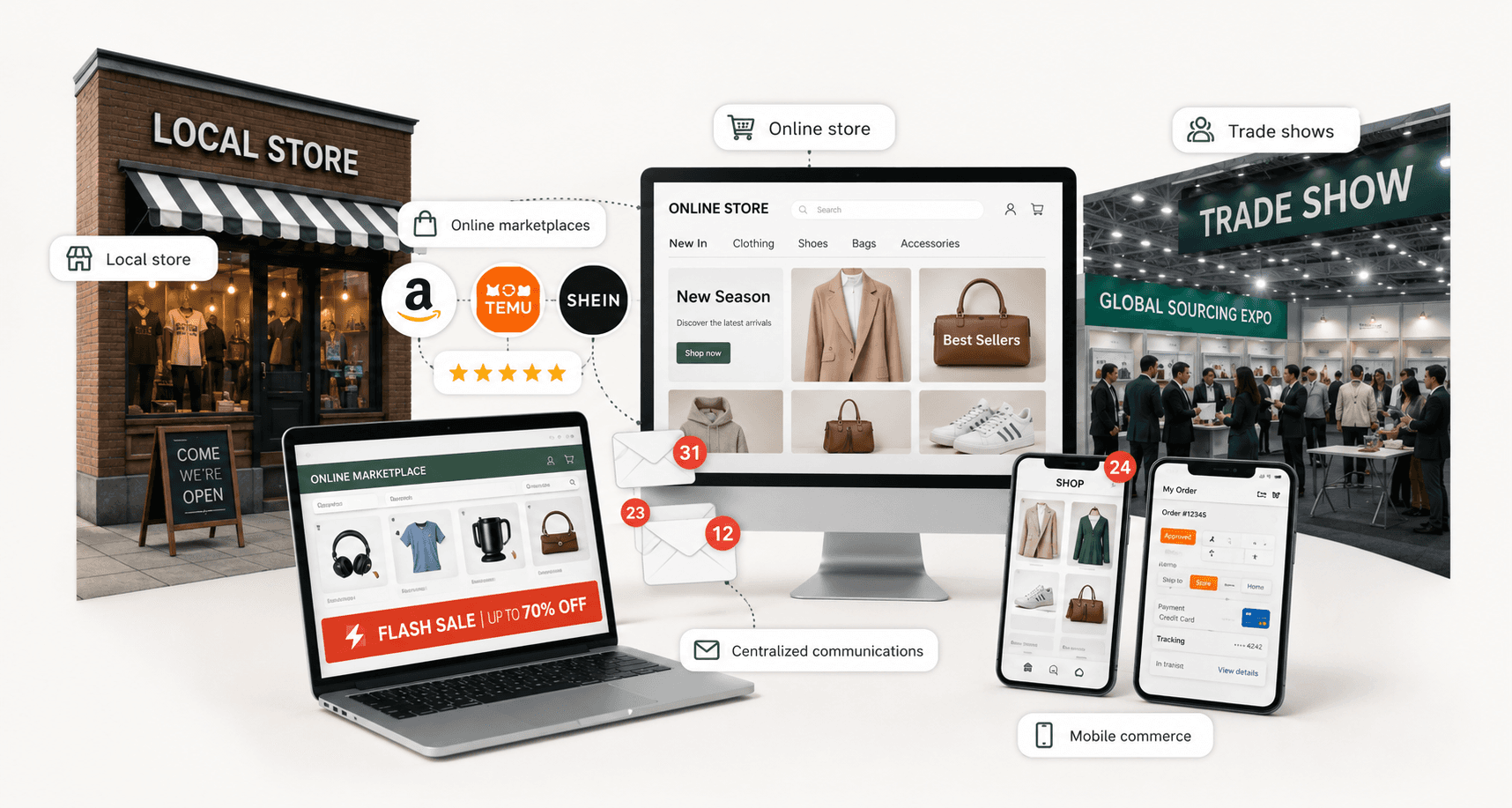
For many brands, the challenge is no longer about adding more channels, but about making them work together.
This is where the shift from multi-channel to channel orchestration becomes essential.
We see this shift clearly with brands on the Orderchamp platform. Bazar Bizar, for example, built strong traction on the Marketplace before expanding into their own B2B Portal, allowing them to maintain control over their brand experience while continuing to benefit from Marketplace visibility.
At the same time, brands like Stëlz are taking a more integrated approach from the start, recently launching their own B2B Portal to better align their different sales channels and create a more consistent buying experience for retailers.
The goal is not to replace one channel with another, but to connect them into one cohesive system.
With Orderchamp Cloud, brands can centralize their wholesale operations and create a consistent experience across all touchpoints. A B2B Portal allows retailers to browse, order, and reorder seamlessly while maintaining alignment across pricing and assortment.
Wholesale operations are becoming more complex
Beyond pricing pressure and changing buying behavior, wholesale operations are becoming significantly more complex. Brands must now handle more orders, more requirements, and more regulatory complexity, especially when operating across borders.
As Ilai from Stëlz explains, retailer expectations themselves have shifted:
“They’ve become more picky… more tailor-made. Like, ‘this is my way, so you should adjust to my needs.’”
This growing demand for customization and flexibility adds another layer of complexity to already fragmented operations.
A key development is structured e-invoicing. In Belgium, B2B e-invoicing becomes mandatory from January 1, 2026, as part of a broader shift toward digital VAT reporting in the EU.
More detailed guidance can be found here:
https://www.ing.be/en/business/payments/peppol-mandatory
At the same time, large ecommerce platforms continue to set new expectations for speed and efficiency.
As Ilse from LOT83 highlights when asked about what retailers expect today:
“Fast changing collections, faster deliveries…”
Retailers are no longer just expecting good products, they expect speed, flexibility, and continuous newness. Together, these shifts are putting increasing pressure on how brands manage their operations, supply chains, and internal processes.
To keep up, brands are increasingly turning to digital solutions.
With Orderchamp Cloud, brands can digitize their wholesale operations through one centralized platform —covering order management, inventory synchronization, invoicing workflows, and multi-channel coordination.
The future of wholesale ecommerce
The wholesale ecommerce market is becoming more challenging in 2026, but it is also becoming more dynamic and opportunity-driven.
According to the International Trade Administration, global B2B ecommerce sales are expected to reach $36 trillion by 2026, growing at a 14.5% compound annual growth rate.
This growth is driven by the continued shift toward digital, self-service purchasing and more connected wholesale ecosystems.
However, growth alone does not guarantee success.
The brands that succeed are those that differentiate beyond price, stay flexible in how they sell, orchestrate their channels effectively, digitize their operations, and build strong retailer relationships.
Ready to future-proof your wholesale operations?
With Orderchamp Cloud, you can:
Launch your own branded B2B Portal
Centralize all your sales channels
Automate order and inventory workflows
Stay compliant with evolving regulations
Offer retailers a seamless buying experience
Build your B2B Portal with Orderchamp Cloud and take control of your wholesale growth.



EUDR 2026: What brands and suppliers actually need to do before 30 December
Industry insights

Orderchamp
5 min read

What to do when the trade show is over: 7 ways to turn leads into wholesale orders
B2B ecommerce
Orderchamp
5 min read

Get ready for the Orderchamp Digital Fair
Product & features
Orderchamp
5 min read