Published on
EUDR 2026: What brands and suppliers actually need to do before 30 December
Contributors

Orderchamp
5 min read

In this article
The EU Deforestation Regulation (EUDR) applies from 30 December 2026. If you sell furniture, tableware, candles with wooden lids, paper goods or anything with natural rubber in it, this one's for you.
The EUDR regulation is an EU-wide effort to curb deforestation and create a more environmentally responsible supply chain.
Here's the good news, and it's real: the regulation got a lot smaller in 2026. Three product categories that everyone assumed were covered have left the scope entirely. Most brands will finish this article knowing they have far less to do than they feared.
What the EUDR actually asks for
The principle is simple. The EU no longer wants products linked to deforestation on its shelves. Seven raw materials are covered: cattle, cocoa, coffee, oil palm, rubber, soya and wood — plus a defined list of products made from them.
If your product is on that list, you need to prove three things:
The material came from land that wasn't deforested after 31 December 2020
It was produced legally in the country of origin
You can point to the geolocation of the plot it came from
That proof is filed as a Due Diligence Statement (DDS) in a central EU information system. The system issues a reference number, and that number travels down the supply chain with the goods.
The important word in all of this is someone. It is very often not you.
Three things that left the scope in 2026
This is where most EUDR advice online is now out of date, so check the publication date on anything you read.
Leather is out. In July 2026 the European Commission adopted a delegated act removing cattle hides, skins and leather from the product list, along with retreaded tyres, soybean seeds for sowing, certain rubber articles, conveyor belts and vehicle seats. The whole leather value chain sits outside the regulation.
Most packaging is out. Material used only to protect, carry or transport another product was already excluded. The 2026 update extends that to all packaging materials regardless of what they're made of, including reusable packaging like crates and pallet pools. Packaging only counts when the packaging is the product you're selling.
One caveat: your packaging is off the hook under this regulation, not under every regulation. The EU packaging rules (PPWR) that took effect in August are a separate obligation with their own requirements.
Printed products are out. Books, newspapers and printed pictures were removed by the December 2025 revision.
What's still in scope
For most brands and wholesalers in this category, it comes down to:
Wood and wood products — furniture, wooden tableware, boards, boxes sold as products, wooden components in mixed-material goods
Paper and cardboard sold as a product — stationery, notebooks, gift wrap, paper decorations
Natural rubber — where it's genuinely natural rubber, not synthetic
One nuance worth knowing: a product only falls in scope if its customs code appears on the official list. A chair with a wooden frame and a steel base isn't automatically covered because it contains wood — you check the code. And anything made entirely from recycled or reclaimed material is exempt.

The two questions that decide your obligations
See whether you must comply with EUDR by asking:
1: Do you sell any of the materials above?
If no, you're done.
2: Do you import it into the EU yourself?
This is the question that decides how much work you do, and it has nothing to do with how big you are.
If you import from outside the EU — if you import furniture from Vietnam, ceramics from India, or rubber goods from Indonesia then you're an operator. You carry the full obligation: gather origin data, collect plot geolocation from your suppliers, assess risk, and file a due diligence statement before the goods go on the market. Penalties for getting it wrong start at 4% of annual EU turnover.
If you buy from an EU supplier who already imported it, then you're a downstream operator. The December 2025 revision created this category specifically to stop compliance work stacking up at every step of the chain. Downstream operators file nothing. Your obligations are:
Ask your supplier for their DDS reference number and keep it
Keep records of who you bought from and who you sold to, for five years
Tell the authorities if you become aware of a genuine compliance problem
Only the first downstream operator after the importer has to collect those reference numbers. Companies further along the chain don't have to pass them on. Larger downstream operators do need to register in the EU information system, but registration is not the same as filing.
For a great many European brands and wholesalers, the entire EUDR project is "collect a reference number from my supplier and store it properly." That's it.
The deadline trap that catches small wood suppliers
You've probably read that micro and small companies get an extra six months, until 30 June 2027. That's true, but not for wood.
Products already covered by the old EU Timber Regulation don't get the extension. The Commission's reasoning is that the timber trade has operated under due diligence rules since 2013 and doesn't need extra runway. So a wooden furniture brand importing from outside the EU needs to comply by 30 December 2026, not June 2027.
Two more details to keep in mind:
The later date applies to operators only. Traders and downstream operators of any size work to December 2026.
The micro/small classification is based on your status as established by 31 December 2024, not your size today.
If you sell wood and you import it, treat December as your real deadline. Being small doesn't buy you time here.
Your 15-week plan
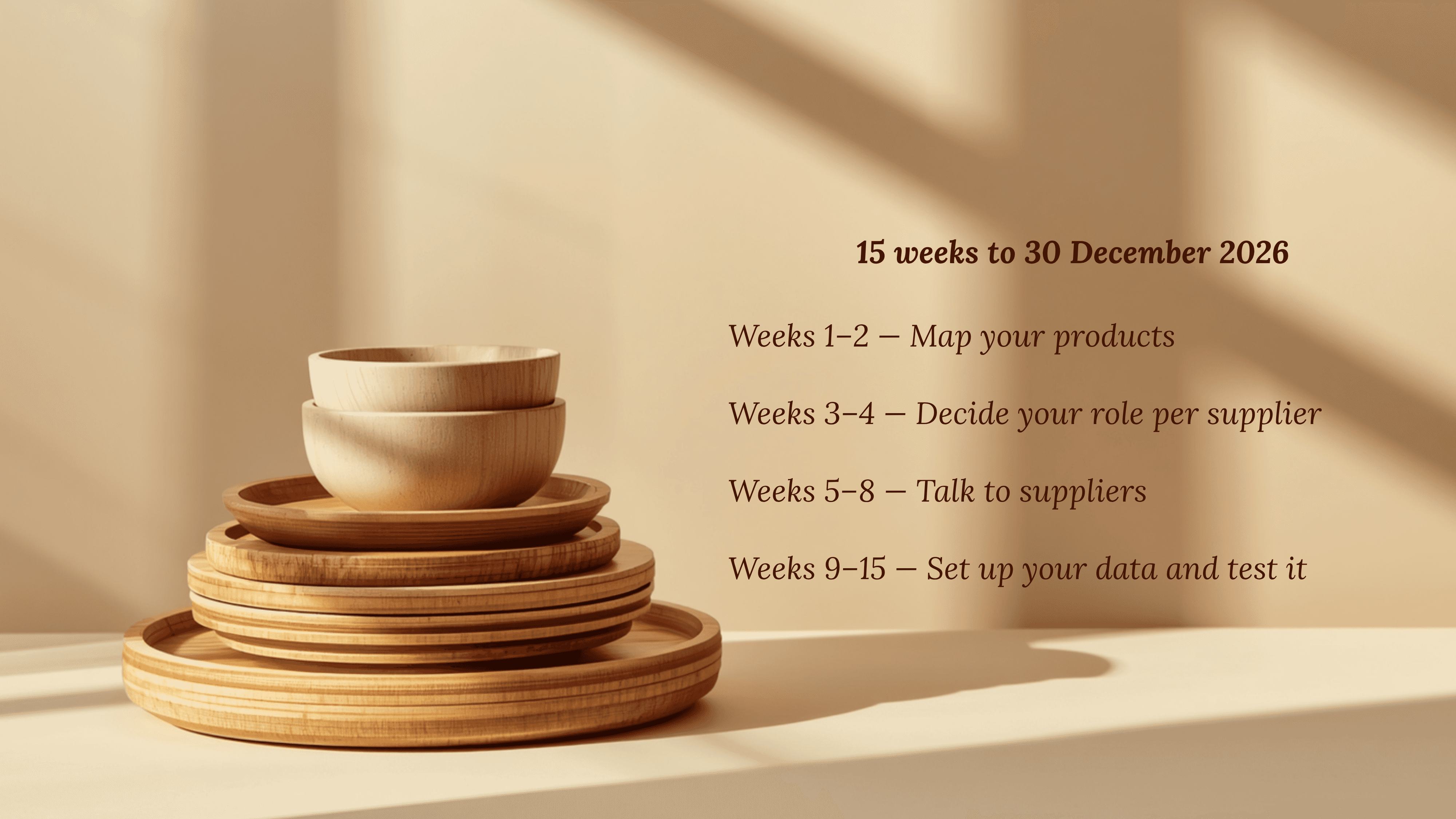
There are roughly fifteen weeks left. That’s still enough time if you start now.
Weeks 1–2: Map your products. Pull your product list and match each item to its customs code. Mark anything containing wood, paper, card or natural rubber, including mixed-material products.
Weeks 3–4: Decide your role, per supplier. For every in-scope product, answer one question: did this enter the EU through us, or through someone else? Importing from outside the EU makes you an operator for that line. Everything else makes you downstream.
Weeks 5–8: Talk to suppliers. If you’re downstream, ask each EU supplier to confirm they’ll provide DDS reference numbers and agree how they’ll send them. If you’re the operator, you need origin data and plot geolocation from your producers, and those conversations can take time.
Weeks 9–15: Set up your data and test it. Reference numbers need a permanent home linked to the product and the order, retrievable for five years. A spreadsheet someone maintains by hand will not survive an audit or a staff change. Attach the data to your product records and your order history instead. If your product data currently lives in an ERP or PIM that doesn’t talk to your sales channels, connecting those systems is the step that makes everything after it easier.
Then test the setup with a real order from start to finish. Can you retrieve the reference number for a specific shipment from eighteen months ago? If yes, you’re ready.
Why your data structure matters more than your paperwork
The thing EUDR really tests isn't your environmental credentials. It's whether your product and order data is clean enough to answer a specific question about a specific shipment years after it left your warehouse.
Brands running wholesale through spreadsheets, WhatsApp threads and email attachments will feel that. Brands running wholesale on a dedicated B2B platform — where every order carries structured product data and the history stays queryable — will find EUDR is mostly a matter of adding one more field.
Selling wholesale into the EU? Orderchamp Cloud gives brands and suppliers a structured B2B wholesale operation — your catalogue, your customers and your full order history in one place, ready for whatever the next regulation asks you to prove. See how other wholesale brands run it.
This article is for general information and isn't legal advice. EUDR obligations depend on your specific products, customs codes and role in the supply chain. For binding guidance, consult the European Commission's official EUDR guidance or a qualified adviser.
Frequently asked questions
Is leather really out of the EUDR?

Do I need to worry about my cardboard boxes and pallets?
I'm a small brand. Don't I have until June 2027?
What's the difference between an operator and a downstream operator?
What happens if I get it wrong?
Does FSC certification mean I'm compliant?
Do I need to do anything about products made from recycled material?