Published on
Introducing the integrations ecosystem connecting all your wholesale data
Contributors

Orderchamp
4 min read

In this article
For wholesalers and brands, growth usually means more systems, not fewer. An ERP for accounting, an ecommerce platform for your webshop, a PIM for product data, a WMS for fulfilment, and a handful of marketing tools on top. The problem isn't the tools — it's the gaps between them. Every disconnected system is another place where stock counts drift, orders get re-keyed by hand, and product data goes stale.
Orderchamp Cloud closes those gaps. Its B2B integrations let you connect ERP, ecommerce, PIM, WMS and payment systems into one workflow, so you can automate order processing, sync inventory in real time, and centralize everything in a single B2B portal. Here's how ERP and ecommerce integration actually works for wholesalers — and the example workflows that make it worth setting up.
Why ERP and ecommerce integration matters for wholesalers
Most wholesale operations run on a "source of truth" system — usually an ERP like Exact Online, AFAS, AccountView or Microsoft Dynamics. That's where your stock, pricing and financial data live. But your customers don't order from your ERP. They order through webshops, marketplaces, sales reps and increasingly through self-service B2B portals.
Without integration, the result is manual work and errors: someone exports a stock file, uploads it somewhere, copies an order from an email into the ERP, and updates a spreadsheet to keep track. Every one of those steps is a chance to oversell, mis-ship, or quote the wrong price.
ERP and ecommerce integration removes the manual layer. Orders flow in automatically, stock levels update across every channel, and product data stays consistent everywhere it appears. Orderchamp Cloud is built specifically for this B2B reality — connecting your existing systems rather than forcing you to replace them.
The Orderchamp Cloud integration ecosystem
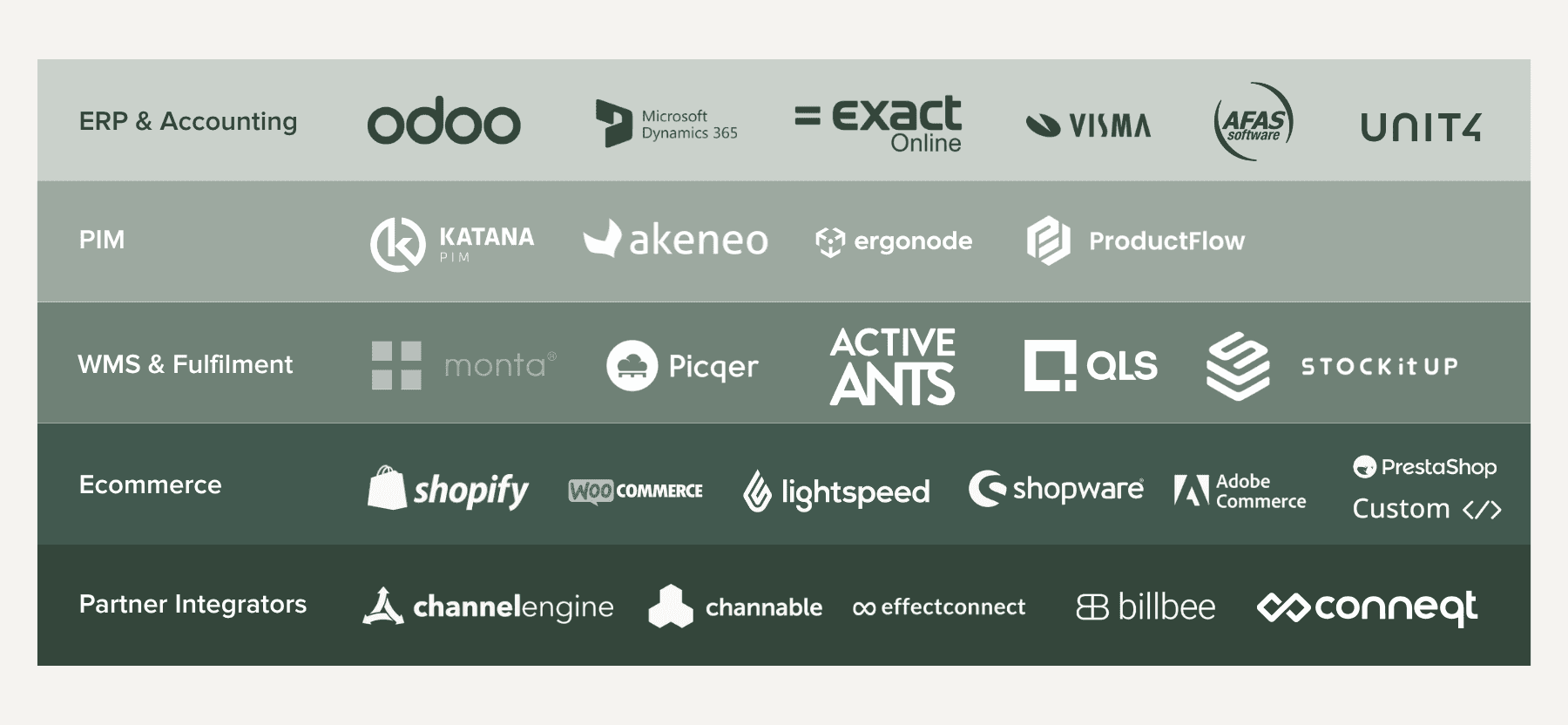
Orderchamp Cloud connects through native integrations, a certified partner network, and an open API. The integration categories cover the full wholesale stack:
Accounting & ERP — AccountView, AFAS, Exact Online, Microsoft Dynamics and more, so orders and invoicing stay in sync with your financial administration.
Ecommerce — Shopify, WooCommerce, Adobe Commerce, so your B2B and marketplace activity builds on the product and stock data you already manage.
PIM (Product Information Management) — Akeneo, so your rich product content flows into every channel from one source.
Multichannel integrators — ChannelEngine, Channable, for pushing catalogs and syncing orders across marketplaces.
WMS & Fulfilment — Active Ants and other warehouse systems, so picking, packing and shipping fit your existing flow.
Payments — to streamline B2B checkout and reconciliation.
Shipping — for automated label creation and tracking.
Marketing & analytics — Google Analytics and Google Tag Manager to track and optimize your B2B portal.
Integration partners — like Alumio, plus a network of certified integrators who can build custom flows in hours or days.
Certified integrators handle setup, from pre-built connections to fully customized workflows, so you're not left wiring systems together on your own.
Example workflow 1: ERP-to-ecommerce inventory sync
This is the classic wholesaler pain point — and the highest-value integration to get right.
Say your live stock lives in Exact Online (or AFAS, Dynamics, AccountView). You sell through a Shopify or WooCommerce storefront and through your Orderchamp Cloud B2B portal. Here's the connected flow:
A retailer places an order through your B2B Portal.
Orderchamp Cloud pushes that order straight into your ERP — no manual entry, no re-keying.
The ERP updates the stock level, and that new level syncs back out to your webshop and portal automatically.
Every channel now shows the same available inventory, so you don't oversell an item that's already committed.
The result: real-time stock accuracy across ERP, ecommerce and your B2B Portal, with zero manual updates. When a warehouse receives new stock, the count refreshes everywhere at once.
Example workflow 2: PIM-driven product data across every channel
Product data is only useful if it's consistent. With Akeneo (or another PIM) as your single source of product truth, the workflow looks like this:
Your team enriches product content — descriptions, specs, images, variants, translations — once, in the PIM.
Orderchamp Cloud pulls that structured data into your B2B Portal and marketplace listings.
A multichannel integrator like ChannelEngine or Channable distributes the same enriched catalog out to marketplaces.
Update a product once, and the change propagates everywhere. No more mismatched descriptions between your webshop, your portal and your marketplace listings — and far less time spent maintaining duplicate catalogs.
Example workflow 3: automated order-to-fulfilment
Connect the front end to the warehouse and the whole cycle runs hands-free:
An order comes in through the B2B Portal or a connected ecommerce store.
Orderchamp Cloud records it in your ERP for invoicing and financial administration.
The order is handed to your WMS or fulfilment partner (like Active Ants) for picking and packing.
A shipping integration generates the label and returns tracking.
Stock decrements in the ERP and syncs back across all channels.
One order, one automated chain — from checkout to doorstep — with your finance, warehouse and sales channels all working from the same data.
Centralizing everything in the B2B Portal
The thread running through all of this is the B2B Portal as your command center. Instead of your team living in five different tools, the portal becomes the single place where orders, customers, pricing and product data come together.
ERP integration keeps the financial and stock data authoritative. Ecommerce and PIM integrations keep product and catalog data consistent. WMS and shipping integrations keep fulfilment moving. Marketing and analytics integrations like Google Analytics and Google Tag Manager let you measure and optimize how buyers actually use the portal. And the open API means that if a system isn't on the native list, it can still be connected.
For wholesalers, that's the payoff of ERP and ecommerce integration: less manual work, fewer errors, accurate stock everywhere, and one centralized B2B portal instead of a pile of disconnected systems.
Getting started
You don't have to rip out your existing stack. Orderchamp Cloud is designed to connect the ERP, ecommerce platform, PIM and WMS you already run — through native integrations, certified integrators, or the API. Setup can take hours or days rather than months, and the certified partner network can build custom flows around your specific processes.
If you're a wholesaler or brand looking to automate order processing, sync inventory in real time, and centralize your operations in one B2B portal, the fastest way to see how the integrations map to your systems is to book a demo of Orderchamp Cloud.
Frequently asked questions
How do I connect my ERP to my webshop?

Can I sell wholesale on Shopify and still manage stock in my ERP?
How can I avoid manually entering wholesale orders into my accounting system?
Do I have to update my product info in every system separately?
How do wholesalers connect their warehouse, webshop and accounting together?
Is it hard to integrate all my wholesale software?
How do I stop overselling stock across different sales channels?



EUDR 2026: What brands and suppliers actually need to do before 30 December
Industry insights

Orderchamp
5 min read

What to do when the trade show is over: 7 ways to turn leads into wholesale orders
B2B ecommerce
Orderchamp
5 min read

Get ready for the Orderchamp Digital Fair
Product & features
Orderchamp
5 min read