Published on
8 practical ways wholesale teams can use AI in daily operations
Contributors

Orderchamp
8 min read

In this article
Once you understand where AI fits, the next step is knowing how to use it in your daily wholesale workflows.
Here are some practical ways AI can support wholesale operations without becoming too technical.
1. Summarizing long retailer emails and customer messages
Wholesale communication can quickly become difficult to manage. Retailers may send long emails with order questions, delivery requests, product feedback, pricing questions, colour requests, or several topics in one message.
AI can help summarize these messages into clear points, so your team can quickly understand what needs to happen next.
For example, you could ask AI to:
Summarize the retailer’s main request
List the action points
Identify urgent questions
Draft a short reply
Turn the message into internal notes
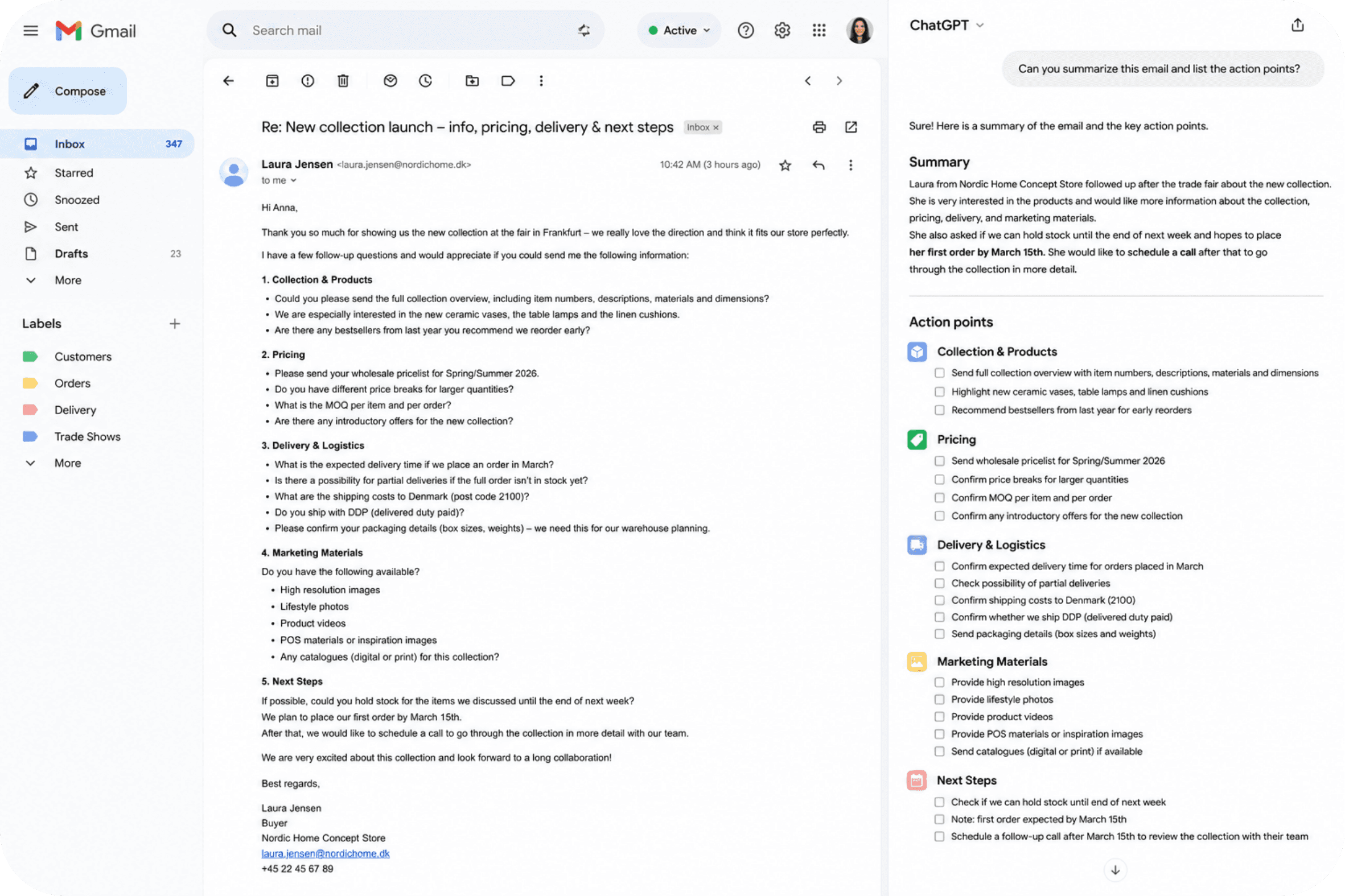
This is helpful when teams receive many retailer emails and need to respond quickly without missing important details. It can also make it easier to decide whether the retailer needs a direct reply, an update in their B2B Portal account, or a follow-up from a sales representative.
2. Drafting wholesale sales follow-ups
Sales follow-up is important in wholesale, but it can take time. After a demo, trade show, customer call, or retailer visit, your team often needs to write a clear and personal message.
AI can help draft a first version based on a few notes.
For example, you could provide:
The retailer’s name
What was discussed
Which products or collections they were interested in
Any questions they had
The next step you want to suggest
AI can then turn those notes into a professional follow-up email. Your sales team can review, adjust, and personalize it before sending.
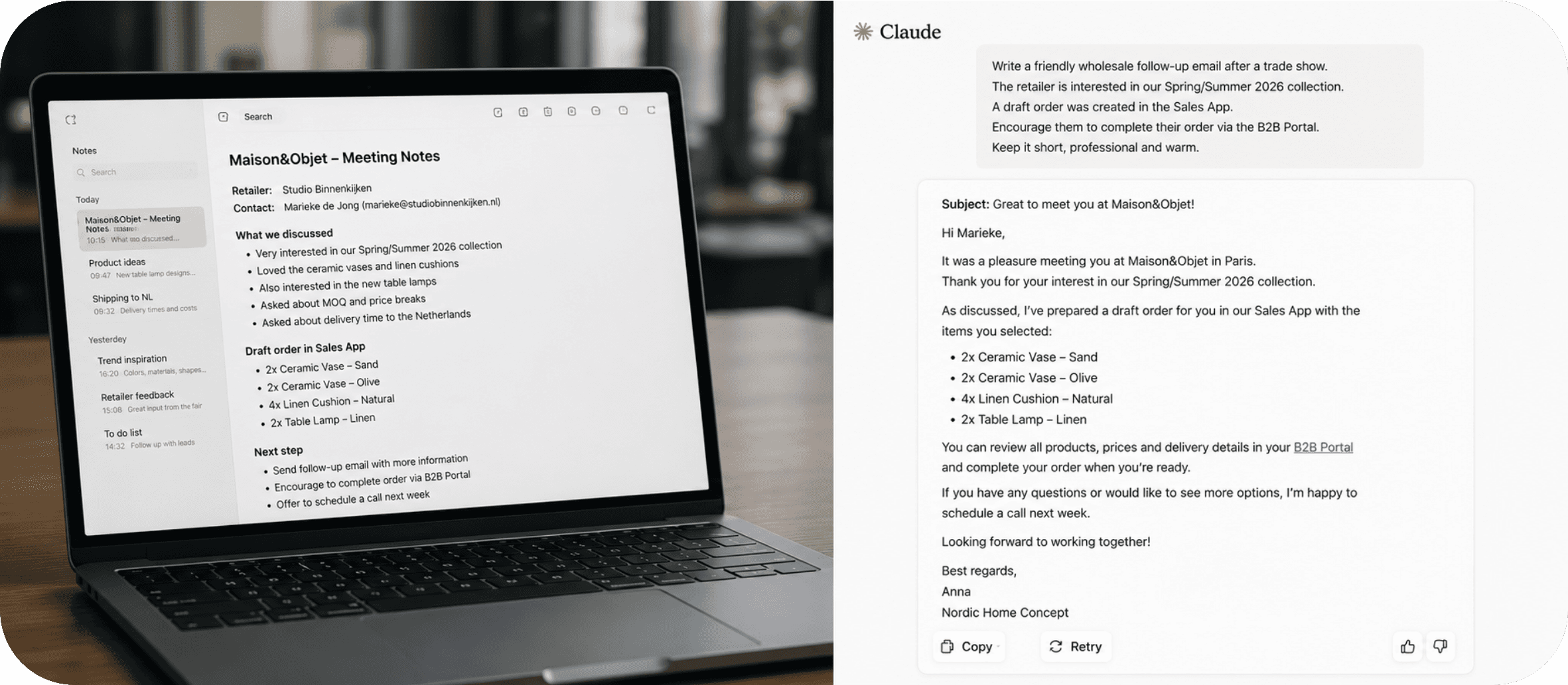
This can be especially useful after a sales visit where a draft order was created in the Sales App. AI can help turn the next step into a clear follow-up email, summarizing the discussed selection and encouraging the retailer to complete their order through the B2B Portal.
This keeps communication moving while still allowing the human relationship to stay at the center.
3. Improving wholesale product descriptions
Product information is essential in wholesale sales. Retailers need clear and complete descriptions to understand whether a product fits their store, customer base, and assortment.
AI can help rewrite or improve product descriptions by making them clearer, more structured, or more commercially appealing.
For example, it can help with:
Turning basic product details into a full wholesale description
Creating shorter versions for catalog pages
Highlighting key benefits for retailers
Rewriting descriptions in a specific tone of voice
Making product texts easier to scan
This can be especially useful for brands with large assortments, where updating every product description manually can take a lot of time.
Clear product content also makes your digital sales channels stronger. Whether retailers browse your assortment through a B2B Portal or your sales reps present products in a Sales App, better product descriptions help buyers understand the value of each item faster.
4. Turning wholesale processes into checklists
Many wholesale processes depend on small but important steps. Think of onboarding a new retailer, preparing a sales meeting, launching a new collection, processing a return request, updating product data, or preparing for a trade show.
AI can help turn rough notes into clear checklists your team can reuse.
For example, a messy list of internal steps can become:
A retailer onboarding checklist
A trade show follow-up checklist
A new collection launch task list
A product data update checklist
A customer support response flow
A reorder campaign checklist
For brands working with a B2B Portal, this could include a checklist for inviting new retailers, updating seasonal collections, checking product images, adding FAQs, or making sure all product details are ready before launch.
For sales teams using a Sales App, it could include a preparation checklist before visiting a retailer or a follow-up checklist after a buyer meeting.
This makes daily work easier to repeat, especially for growing teams where knowledge is often spread across different people.
5. Creating first drafts for wholesale marketing content
Wholesale marketing teams often need to create content from product launches, customer stories, seasonal campaigns, new collections, feature updates, or industry insights.
AI can help create a first draft faster.
It can support with simple content tasks such as:
Blog outlines
LinkedIn posts
Newsletter introductions
Product launch announcements
FAQ sections
Campaign ideas
Short social captions
Collection descriptions
For example, if you are launching a new collection in your B2B Portal, AI can help draft a short announcement for retailers. If your sales team is preparing for a new buying season, AI can help create talking points that match the products your team will present in the Sales App.
The final message should still be reviewed by your team to make sure it fits your brand voice, audience, and commercial goal. But AI can help get the first version on paper, which is often the hardest part.
6. Organizing retailer feedback
Retailer feedback can come from many places: emails, calls, support tickets, sales conversations, surveys, trade shows, and chat messages. It is valuable information, but it can be hard to turn into clear insights.
AI can help group feedback into themes.
For example, you could ask it to organize feedback by:
Product questions
Delivery issues
Pricing concerns
MOQ questions
Colour or size requests
Feature requests
Common objections
Positive retailer comments
This can help wholesale teams spot patterns more easily and understand what retailers are asking for most often.
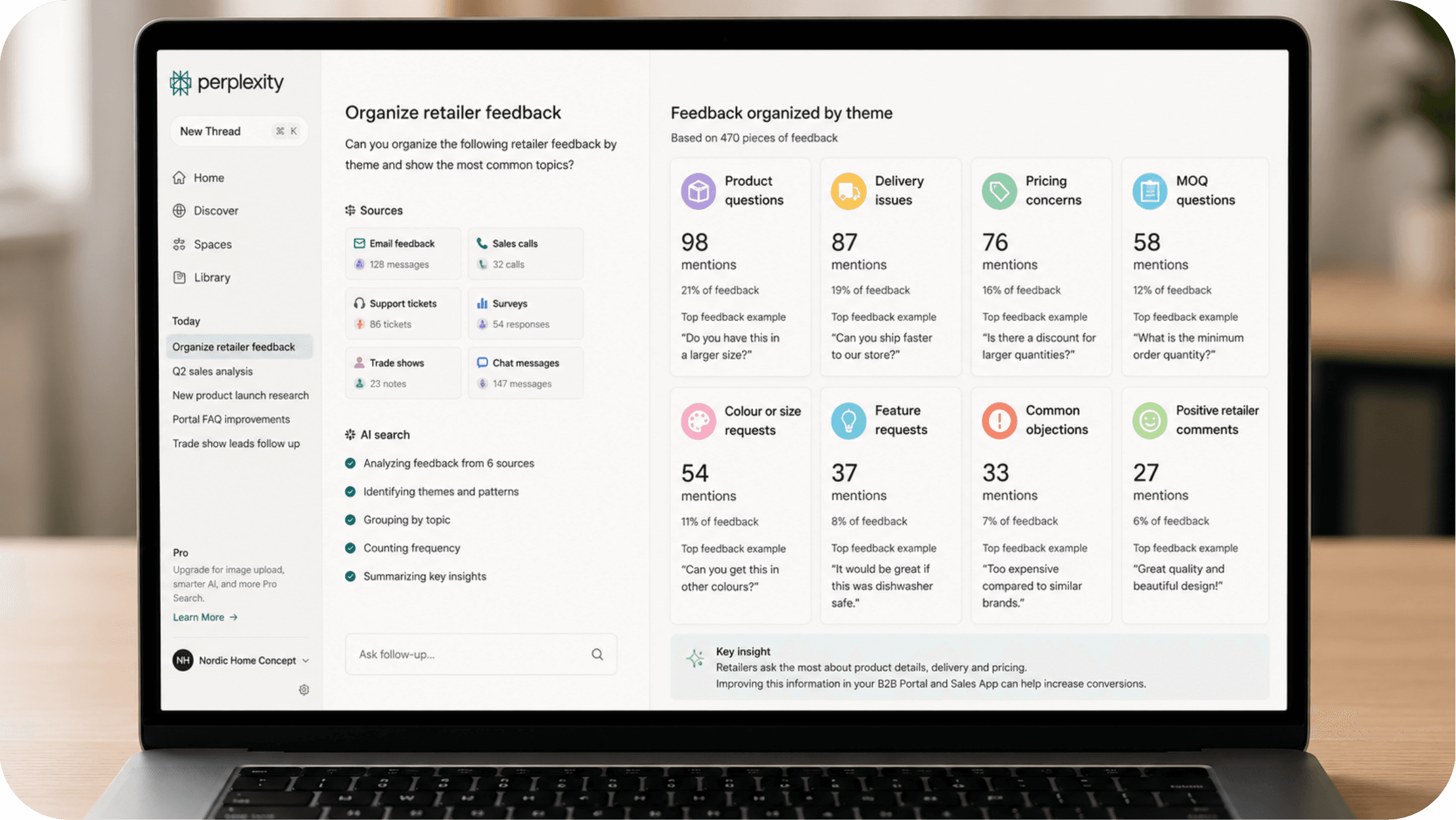
Those insights can then support your wider sales process. If retailers often ask the same questions before ordering, you might add clearer information to your B2B Portal. If sales reps hear the same objections during store visits, you can prepare stronger explanations or product notes for the Sales App.
7. Explaining complex wholesale information in simpler language
Wholesale brands often deal with operational or product-specific information that is not always easy to explain. Think of order minimums, lead times, shipping rules, product specifications, return conditions, preorder timelines, or collection availability.
Sometimes, that information needs to be rewritten for a different audience.
AI can help translate complex explanations into simpler language.
For example, it can help rewrite:
Internal process notes into retailer-facing instructions
Technical product information into a simple sales explanation
Long policy documents into short summaries
Collection updates into clear customer benefits
Operational updates into easy-to-understand emails
Order terms into a short FAQ section
This is useful when different teams need to communicate the same information in different ways.
A product manager may write detailed internal notes, while a sales team needs a short explanation for a retailer conversation. AI can help turn that same information into a format that works for your B2B Portal, your Sales App, or your retailer emails.
8. Preparing simple retail and market research
AI can also help with research, especially when your wholesale team needs a starting point quickly.
For example, you can use AI to explore:
Retail trends
Seasonal product themes
Common retailer questions
Competitor positioning
Industry terminology
Blog topic ideas
Buyer pain points
Category-specific market insights
This does not mean AI research should be copied directly. Your team should still check sources, validate the information, and add your own expertise.
But AI can help you move from “Where do we start?” to “Here are the main points we should look into.”
How to get better results from AI
AI works best when you give it enough context. A vague request will usually lead to a generic answer, while a specific request will give you something much more useful.
Instead of asking:
“Write a follow-up email.”
Try asking:
“Write a friendly wholesale sales follow-up email after a store visit. The retailer was interested in our new home decor collection, a draft order was created in the Sales App, and we want to encourage them to complete their order through the B2B Portal. Keep it short and professional.”
A good AI prompt usually includes:
What you want the AI to create
Who the audience is
What information should be included
What tone of voice you want
How long the output should be
Any details the AI should avoid
The better your input, the more useful the output will be.
A few things to keep in mind
AI can be a very useful assistant, but it should not be treated as a replacement for human review.
Wholesale teams should always check the output before using it, especially when it involves customer communication, pricing, legal information, product claims, order terms, or sensitive business data.
It is also important to avoid sharing confidential customer information unless your company has approved the tool and the right data policies are in place.
The best way to use AI is as a support tool: let it help you prepare, summarize, structure, draft, and research, while your team stays responsible for the final decision.
A simple way to work smarter
AI does not have to be used for advanced automations or complex projects to be valuable. For many wholesale teams, the biggest benefit starts with simple daily tasks.
Summarizing retailer emails, drafting follow-ups, improving product descriptions, organizing feedback, creating checklists, and preparing research may seem small. But together, these tasks take up a lot of time.
When combined with the right digital tools, these simple tasks can become even more valuable. A B2B Portal can make ordering easier for retailers, a Sales App can support sales teams during customer visits, and AI can help prepare the content, communication, and internal structure around those workflows.
The result is not just more productivity. It is more space for your team to focus on the work that really needs a human touch: building relationships, supporting retailers, and growing your wholesale business.
Frequently asked questions
Do I need technical knowledge to start using AI in wholesale?

What are the best wholesale tasks to automate with AI?
How can I get better results from AI?
Is it safe to share customer information with AI?
How does AI work alongside tools like a B2B Portal or Sales App?



Upcoming wholesale trade shows in the Netherlands: the brand's guide to what's coming up near you
Guides
Orderchamp
5 min read

B2B Next Summer Edition: familiar stories, new perspectives
Industry insights
Orderchamp
5 min read

Wholesale order automation: a simple step-by-step guide
B2B ecommerce
Orderchamp
5 min read