Published on
Digital Product Passport (DPP) for textiles: the timeline, and what to do now
Contributors

Orderchamp
6 min read
In this article
Two things are true about the Digital Product Passport, and most coverage only tells you one of them.
The first is that it is not imminent. For textiles, the delegated act that will actually define the requirements is planned for the fourth quarter of 2027, and the obligations arrive some time after that.
The second is that the work it requires takes longer than the notice you will get. A passport is a product data problem, and product data is the slowest thing in a wholesale business to fix. Brands that start when the act is published will be doing in twelve months what they could have done gradually over three years, during their busiest seasons, under a deadline.
What already applies
Since 19 July 2026, large companies have been banned from destroying unsold clothing, clothing accessories and footwear in the EU. Medium-sized companies come under the same rule in 2030. The Commission adopted the accompanying derogations in February 2026, covering cases such as goods that genuinely cannot be made fit for reuse.
The scale behind it: the European Commission estimates that 4-9% of textile products placed on the European market are destroyed before anyone uses them, somewhere between 264,000 and 594,000 tonnes a year.
That number is a production and forecasting problem before it is an environmental one, and it is worth reading as a warning about where the rest of this is heading. Overproduction is getting expensive in ways that do not show up in your cost price.
What a Digital Product Passport actually is
A DPP is a digital record attached to a product, reachable from a data carrier on the item, holding information about what it is, what it is made of, where it came from and what can be done with it at the end of its life. It comes from the Ecodesign for Sustainable Products Regulation (ESPR), which has been in force since July 2024 and under which textile apparel is a priority product group.
The European Commission has published the categories it expects the textile passport to cover, while being explicit that the detail comes later in the delegated act. On its textiles and apparel page those categories are product identification and characteristics, fibre composition where relevant under the Textile Labelling Regulation, information supporting use, repair and maintenance, information on reuse, resale, disassembly, refurbishment, disposal and recycling, origin information, and identification of the relevant economic operators.
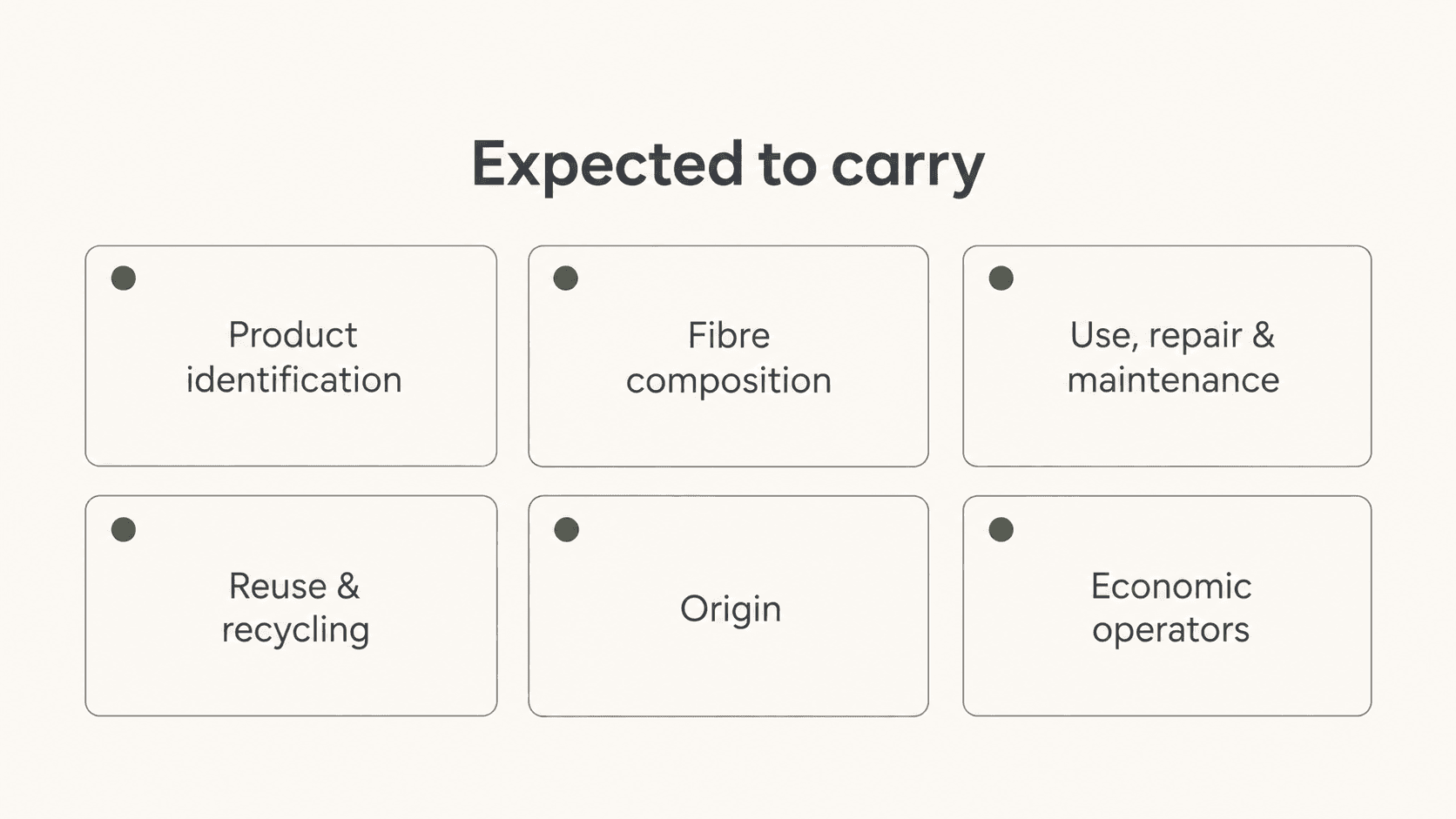
Read that list as a brand rather than as a compliance officer and one thing stands out: almost all of it is information you already hold somewhere. The problem is that it is spread across a supplier email, a tech pack, a spreadsheet, a label approval and somebody's memory, and none of it is attached to the thing it describes in a form a machine can read.
The timeline

In force now. ESPR, since 18 July 2024. The unsold goods destruction ban for large companies, since 19 July 2026.
Q4 2027. Planned adoption of the ESPR delegated act for textiles, which will set the ecodesign requirements and the passport's data fields together. The European Commission notes that implementation timelines may evolve as the work progresses, which is worth taking at face value since this date has moved before.
After that. No application date has been set. A transition period of around 18 months after adoption is what most advisers expect, which would put the first obligations somewhere in 2029.
2028. The ESPR working plan is due for review, which may change what sits in scope and when.
So in short: no deadline this year, and a two to three year runway. The useful question is not when you have to comply, but what you would want to have already done by the time you do.
Who it lands on
The obligations fall primarily on economic operators placing textile apparel on the EU market — manufacturers, producers and importers. If you are a brand producing your own range and selling it into the EU, that is you, and it applies whether or not you are based in Europe.
Retailers and distributors are not off the hook either. They have to ensure a passport is available for the products they handle, which has a consequence worth seeing coming: your stockists will eventually need something from you, and the larger ones will start asking long before the law requires it. That is how PPWR and the packaging rules played out.
Why this is a product data project
Here is the part that makes a DPP different from most compliance work since it is granular. A passport attaches at the level of the product as it is sold, which means the record has to resolve to a specific item, not to a style with four colorways behind it.
Most wholesale brands are not set up for that. One SKU covering several variants is extremely common, and it is already the source of picking errors and wrong-item claims. It is also, more quietly, a thing that makes a passport impossible to attach correctly. Fixing SKU structure is slow as it touches every system you have, and nobody ever wants to do it in a busy season. It is also the single most useful thing you could start this quarter.

The second piece is supplier information. Fibre composition, origin, and materials data come from your suppliers, and the honest position for most brands is that they have some of it, in inconsistent formats, for some of their range. Collecting it properly takes more than one production cycle, because the mechanism is asking your suppliers at the moment you place an order rather than chasing them afterwards.
The third is simply having one place where product data lives. If the authoritative version of a product's information is a spreadsheet that gets copied each season, there is nothing to attach a passport to. That is the same underlying problem as a product catalog that goes stale, and it is why this work pays for itself regardless of what the delegated act says in 2027.
What to do in the next year
Start with SKU structure, because everything else attaches to it. One identifier per sellable variant, consistently, across every system.
Then add the fields to your product records now, even while they are incomplete: composition, country of manufacture, supplier, care and repair information.
Change what you ask suppliers for at the point of ordering, rather than planning a data collection exercise later. The information arrives most reliably when it is a condition of the purchase order.
And look hard at unsold stock, because the destruction ban is already live for large companies and heading for everyone else. That is partly a forecasting question, which for seasonal brands means how you run pre-orders and how closely production follows committed demand rather than optimism.
Where Orderchamp Cloud fits
Running your catalog in a B2B Portal means product data has one authoritative home, with a record per variant, maintained once rather than rebuilt every season. That is the structure a passport eventually attaches to, and in the meantime it is what makes your order management accurate and your catalog current. Brands that tidy their product data for commercial reasons now will find the compliance version of the job mostly done.
Want your product data in one place before anyone requires it? Book a demo or see plans.
This article is a general overview and not legal advice. The textile delegated act has not been adopted, so the data requirements and application date described here are expectations rather than settled rules. Check the European Commission's pages, linked above, for the current position.
Frequently asked questions
When does the Digital Product Passport become mandatory for textiles?

Is anything about this already in force?
Who has to provide a Digital Product Passport?
What information will the passport need to carry?
Does this apply to small brands?
What's the first thing to fix?
Do I need special software for this?



What buyers actually look at when deciding to stock a new brand
Wholesale strategy
Orderchamp
6 min read

EUDR 2026: What brands and suppliers actually need to do before 30 December
Industry insights

Orderchamp
5 min read

What to do when the trade show is over: 7 ways to turn leads into wholesale orders
B2B ecommerce
Orderchamp
5 min read