Learn how to manage wholesale orders efficiently with a B2B ordering portal and wholesale order management software. Automate manual workflows, integrate your ERP, and scale B2B sales with Orderchamp Cloud.

In this article
Managing wholesale orders is one of the biggest challenges for modern brands. As B2B ecommerce keeps evolving, more businesses are searching for how to manage wholesale orders in a way that's scalable, efficient, and future-proof. Increasingly, the answer is a B2B ordering portal that replaces manual processes with a structured, digital wholesale ordering system.
When brands think about how to manage wholesale orders, they're usually wrestling with fragmented workflows. Orders come in by email, inventory lives in spreadsheets, and data gets keyed into ERP systems by hand. This outdated approach to wholesale order management makes it hard to process B2B orders efficiently — especially as volume grows. Moving to wholesale order management software removes those inefficiencies.
Brands that want to grow are shifting toward self-service ordering, where retailers place their own orders through an online B2B portal. This lets companies automate wholesale orders, cut manual work, and give customers a more consistent experience — managing everything through one connected B2B sales platform instead of disconnected tools. For many, the first step is simply to replace Excel for wholesale orders.
The problem with traditional wholesale order management
Despite the shift to digital tools, many brands still manage wholesale orders with Excel sheets, manual order entry, and trade-show orders processed by hand. These workflows may feel manageable at first, but they quickly become a bottleneck for growth.
The biggest issue is duplicated work. Orders arrive in one format and get re-entered into another system, which increases errors and slows everything down. Without a centralized order system, it's difficult to process B2B orders efficiently or scale.
As one brand put it:
"We received all orders through Excel and then had to manually enter them into Lexoffice, so it was double the work."
This example from Ma Chérie Mon Amour captures a common problem: without a proper wholesale ordering portal, teams spend valuable time on repetitive admin instead of growing the business.
Another limitation is the lack of integration. Without ERP integration, systems stay disconnected, leading to outdated stock levels and inconsistent pricing. Connecting your portal to your ERP is essential for brands that want to automate their wholesale ordering workflow end to end.
For a deeper look at how manual processes stall growth, see How manual B2B orders are stalling your wholesale growth (and how to automate them).
How to manage wholesale orders at trade shows with a sales app
Trade shows are still an important sales channel, but they expose the weaknesses of manual order management. Orders get written down, collected in spreadsheets, or emailed after the event — creating delays and mistakes.
A better way to manage wholesale orders on the show floor is a B2B order taking app that connects directly to your B2B ordering portal. Instead of capturing orders by hand, sales teams enter them straight into your digital ordering system and sync them centrally.
This lets brands process orders in real time. Orders sync instantly to the online portal, removing the need for manual entry later, and when paired with ERP integration, inventory and pricing stay accurate throughout. A dedicated trade show ordering app effectively extends self-service ordering into offline environments, so you can automate order capture even during high-volume events.
How Orderchamp cloud helps you manage wholesale orders
Orderchamp Cloud brings all of these elements together into one connected B2B sales platform, built specifically to help brands manage wholesale orders through a centralized system that replaces manual workflows.
With a branded B2B ordering portal, companies can create a wholesale storefront where customers browse products, view their pricing, and place orders independently — no manual processing required. It also works as a powerful online ordering system, letting brands automate orders and streamline operations. Through ERP integration, all data syncs in real time for accurate, up-to-date wholesale order management.
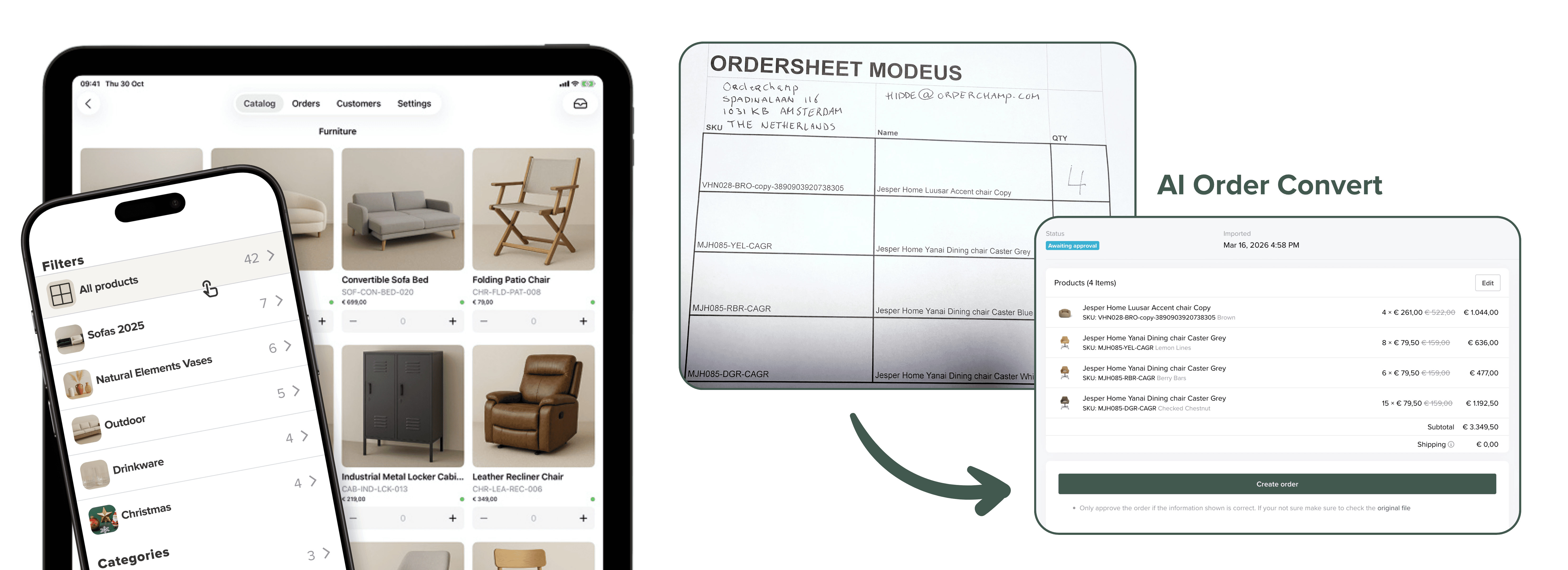
One of the key innovations is AI Order Convert: it instantly processes incoming orders from emails, PDFs, or trade shows and turns them into structured order data automatically — no re-typing. Combined, these capabilities let brands process B2B orders efficiently while scaling across every channel with a multi-channel B2B sales strategy.
The future of managing wholesale orders with AI
The future of how to manage wholesale orders is increasingly defined by automation and AI. As more brands adopt digital ordering systems, AI Order Convert will play a central role in wholesale order management by eliminating manual data entry — so brands can process orders instantly and accurately.
A B2B ordering portal will remain the foundation of this ecosystem, supported by self-service ordering and real-time sync. Together, these tools create a connected B2B sales platform that lets businesses handle B2B orders efficiently at scale — often the fastest way to build your own B2B webshop without developers.
As platforms like Shopify show, the shift toward digital, automated commerce is accelerating. Brands that invest in a wholesale ordering portal, AI Order Convert, and ERP integration will spend less time on operations and more on growth.
Conclusion: A smarter way to manage wholesale orders
For brands figuring out how to manage wholesale orders, the most effective solution is a B2B ordering portal backed by a digital, self-service ordering system. It lets you automate wholesale orders and simplify operations in one place.
By combining a centralized order system, automated order processing, and AI Order Convert, brands can manage wholesale orders with far greater speed and accuracy — building a connected B2B sales platform that handles orders efficiently, without operational bottlenecks.
Managing wholesale orders is no longer about handling complexity. It's about removing it entirely through automation, integration, and a modern B2B ordering portal that supports long-term growth.