Published on
B2B Portal, one year on: How 7 brands across 7 categories are running wholesale their way
Contributors

Orderchamp
12 min read

In this article
When we launched the B2B Portal in May 2025, the premise was straightforward. Wholesale shouldn't require emailing PDFs back and forth, chasing payments over WhatsApp, or maintaining a legacy B2B system that takes six months to set up and a full-time developer to support. Brands deserve an ordering portal that looks like theirs, runs like a modern webshop, and automates the manual work in the background.
Twelve months in, brands of every shape and size have launched their own private portals with Orderchamp Cloud. To mark the one-year anniversary of the B2B Portal, we've selected seven customers across seven categories, each demonstrating a different approach to the same platform. From Bavarian gourmet gift sets to crystal-infused skincare in Amsterdam, here's how they're each using their B2B Portal — and why Orderchamp Cloud fits the way their category actually buys.
1. Lot83 — Fashion
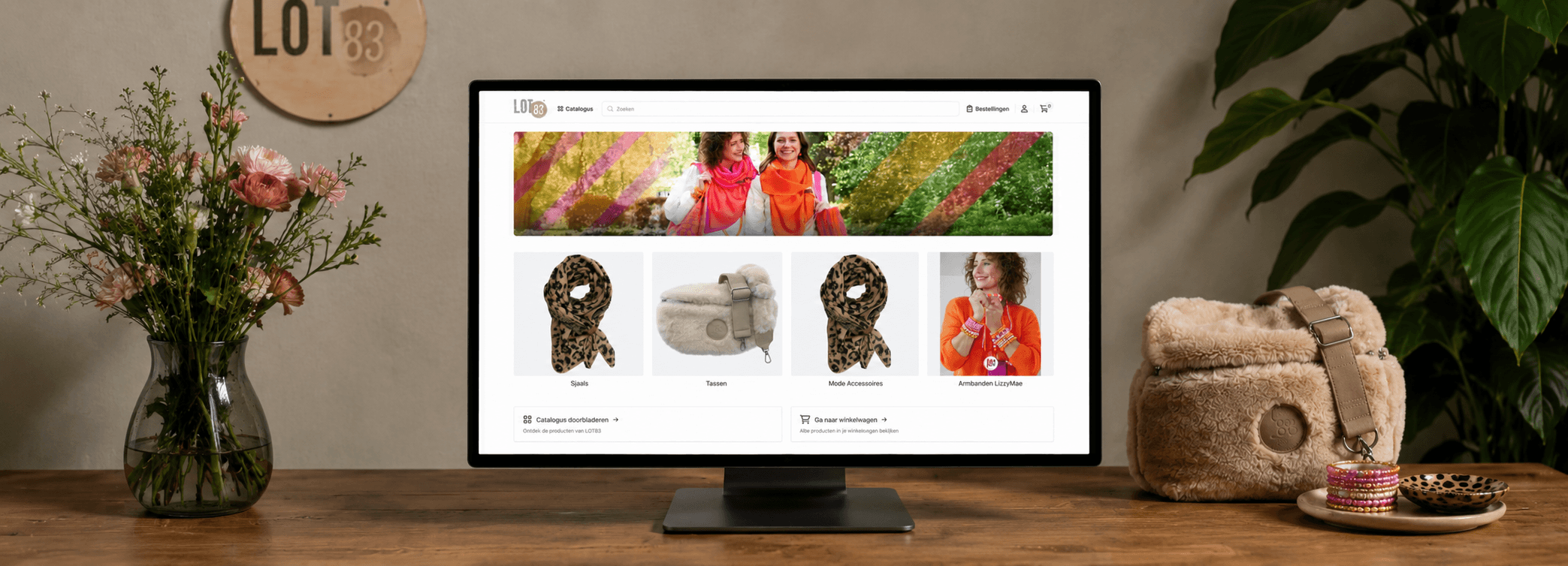
Trendzz BV runs the Dutch fashion brand LOT83 out of Dongen, in the south of the Netherlands. The collection is built around scarves, cardigans, hair bands, bags, and caps — all finished with a signature leather detail — and shows at TrendSet in Munich twice a year. Their wholesale operation runs through a dedicated Orderchamp Cloud B2B Portal at lot83.orderportal.com, alongside a physical showroom in Dongen for buyers who prefer to evaluate the fabric in person. What stands out about their configuration is that the portal isn't only a catalog — it carries the entire wholesale relationship. Dedicated pages for the showroom, the fairs LOT83 attends, and the team's contact details all sit under the same login as the order flow. A boutique owner who first encountered the brand at TrendSet can return later, browse the new collection, book a showroom visit, and place an order without leaving the portal. The whole platform operates in Dutch, English, German, and French, reflecting the regions where their retailers are concentrated — Benelux, DACH, and France.
Why this portal works for Fashion
Fashion depends on speed and seasonality. Buyers want to see new arrivals the moment they launch, place orders without a phone call, and trust that what they see in the catalog is what will actually ship. But fashion also still takes place in person — at trade fairs, in showrooms, with the fabric in hand. Orderchamp Cloud handles the digital requirements a fashion brand needs most — real-time stock sync, customer-specific pricing for different retailer tiers, multi-language support, and a branded shop experience that reflects the brand rather than a marketplace — while giving the brand a place to anchor the offline elements as well: showroom appointments, fair schedules, contact details. For a brand like LOT83 that sells to boutiques across four countries and exhibits at a major German trade fair, that link between digital and physical wholesale is critical.
LOT83 also illustrates something broader about how Orderchamp Cloud is being used in practice: one company, multiple brands, multiple portals. Trendzz BV doesn't only run LOT83 — they operate sister brands on separate Orderchamp Cloud storefronts, each with its own branding, buyer login, and catalog logic. The same company sits in the background, with completely distinct trade experiences in the front. For brands with multiple lines that have historically been forced to either combine everything into one large catalog or build and maintain entirely separate B2B systems, this is a meaningful advantage: a clean, fully branded portal per brand without rebuilding anything. Orderchamp Cloud handles the wholesale infrastructure; the brand retains full control of the storytelling.
2. Sidedish — Stationery
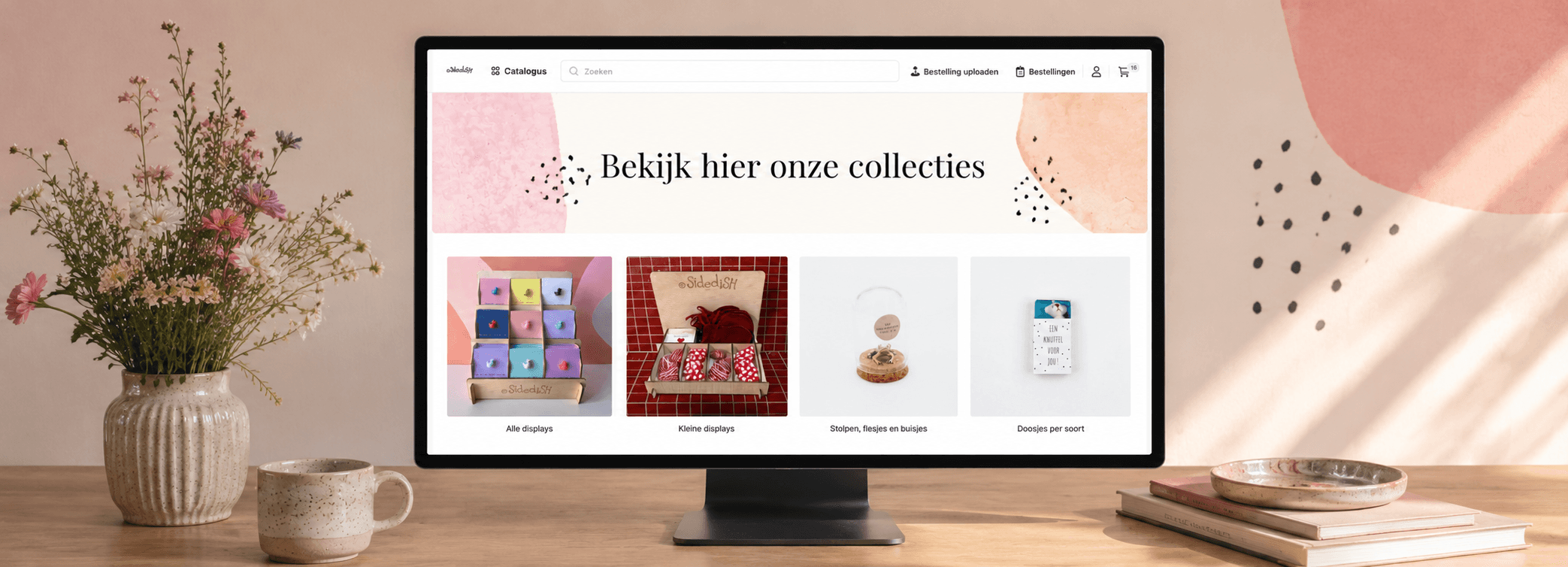
Sidedish, based in Heiloo in North Holland, makes greeting cards, lucky-charm pouches, mini-displays-in-a-jar, gift box assortments, and the kind of small letterbox gifts found on the counters of independent Dutch shops. Their B2B Portal lives at sidedishcards.nl — and what makes it distinctive isn't any single feature, but the philosophy underneath.
Sidedish doesn't primarily sell individual products. They sell small wooden displays, pre-loaded for the shop counter — a riser stocked with twelve lucky-charm pouches, a tray of matchbox-sized teddy gifts, a stand of tiny glass bottles containing messages. Rather than organizing their portal around SKUs the way most B2B catalogs do, they've structured it around the way their buyers' shops actually operate. The catalog has two parallel entry points: a set of categories for product types (greeting cards, jewelry, small gifts, gift cards), and a separate sidebar of occasions — Father's Day, Christmas, Easter, Valentine's, end-of-school-year, graduation, lucky charms, love. A florist filling their counter for Mother's Day shops one way; a gift shop restocking their card spinner shops another. The same portal supports two completely different mental models at once.
The detail work is equally considered. Filters include Language — because the card sets come in multiple languages, and a Belgian buyer shouldn't have to scroll past Dutch-only stock. The header offers an option for buyers who want to drop in a CSV, alongside a download product list option to pull the catalog into their own systems. The homepage banner doesn't lead with a hero product — it leads with "View our collections," placing the curated displays front and center. The portal reads as though it was designed by someone who has stood behind the counter of a Dutch gift shop and observed how buying really happens.
Why this portal works for Stationery
Stationery is a high-SKU, low-ticket business. A single retailer might add 16 different small items to one basket — which is exactly what a typical Sidedish cart looks like. That breaks most B2B systems, which were built around bulk SKUs and case packs. Beyond raw volume, stationery buyers think in displays and moments — they're not restocking one line, they're filling a counter for an upcoming holiday or refreshing the spinners for spring. Orderchamp Cloud handles the volume cleanly, the bulk-order grid lets a buyer assemble a 40-line order in minutes, and the ability to organize a catalog along two dimensions at once — by product type and by occasion, with niche filters like language — means a stationery brand can sell the way the category actually merchandises. Low MOQs, CSV uploads, downloadable product lists, and branded displays presented as collections turn a niche cards-and-gifts brand into something a buyer can restock on a slow Tuesday morning without picking up the phone.
3. Genial Genießen GmbH — Food & Beverages
Genial Genießen — sometimes shortened to GeGeGe, for Genial Genießen Gerblinger — is a German gourmet gift business based in Wertingen, Bavaria. Founder Andreas Gerblinger is a fifth-generation retailer who built the company around a specific idea: take exceptional products from small and mid-sized German family manufacturers — vinegars, oils, spices, wines, spirits, sweets, fruit spreads, BBQ sauces, beer, teas — and combine them into beautifully packaged, ready-to-give gift sets. No flavor enhancers, no preservatives, no mass-market shortcuts. Their B2B Portal is online at b2b.genial-geniessen.com.
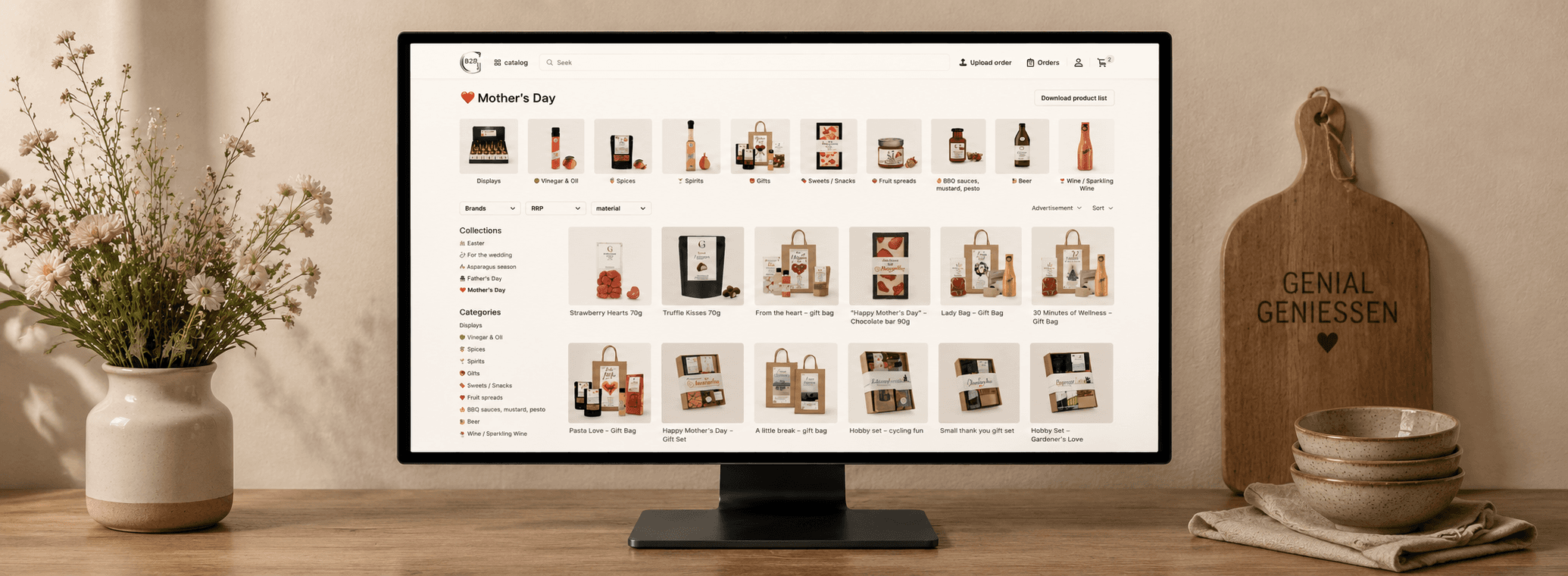
The defining feature of their portal configuration is that it's organized around the moment of giving, not the product itself. When a buyer lands on a page such as the Mother's Day collection, they're not browsing a flat list of jars and bottles — they see curated gift bags (Lady Bag, 30 Minutes of Wellness, Happy Mother's Day) sitting alongside the loose components a shop might want to merchandise around them. The left sidebar runs entirely on occasions and seasons: Easter, For the wedding, Asparagus season, Father's Day, Mother's Day. The top tiles use product-category emojis (🥗 Vinegar & Oil, 🌶️ Spices, 🍸 Spirits, 🎁 Gifts, 🍫 Sweets / Snacks, 🍓 Fruit spreads, 🔥 BBQ sauces, 🍺 Beer, 🍷 Wine) so a buyer scanning for, say, a BBQ-themed Father's Day display can find it in a single glance. An RRP filter sits alongside Brands and Material, an upload order button in the header supports buyers placing CSV-based reorders, and a download product list option serves shops that work offline. It's a portal designed around the understanding that its buyer is filling a counter for a specific moment, not simply restocking a SKU.
Why this portal works for Food & Beverages
Food and beverages introduce their own complexities: shelf life, batch consistency, varying minimum order quantities for shippable cases, allergen and ingredient disclosure, and a wide range of buyer types (gourmet shops, delicatessens, garden centers, corporate gifting clients, hotel boutiques). On top of that, the category is fundamentally seasonal — Easter brunches, Mother's Day brunches, Father's Day grilling, asparagus season, Christmas hampers — and the buyer's role is to fill their shelves for whichever moment is approaching next. Orderchamp Cloud lets a food brand surface case sizes and RRPs cleanly, organize the same product across multiple seasonal collections without duplicating SKUs, and present the catalog the way the buyer actually shops — by occasion, by audience, by gift type. Combined with a multilingual branded portal, RRP visibility for margin calculations, and CSV upload for the larger trade accounts placing major seasonal reorders, the result is a wholesale flow that matches the operating norms of gourmet retail.
4. natubini GmbH & Co. KG — Kids & Baby
natubini is the brand side of Dimo-Tex, a German textile group based in Wenden, North Rhine-Westphalia. Their B2B Portal is live at natubini.orderportal.com.
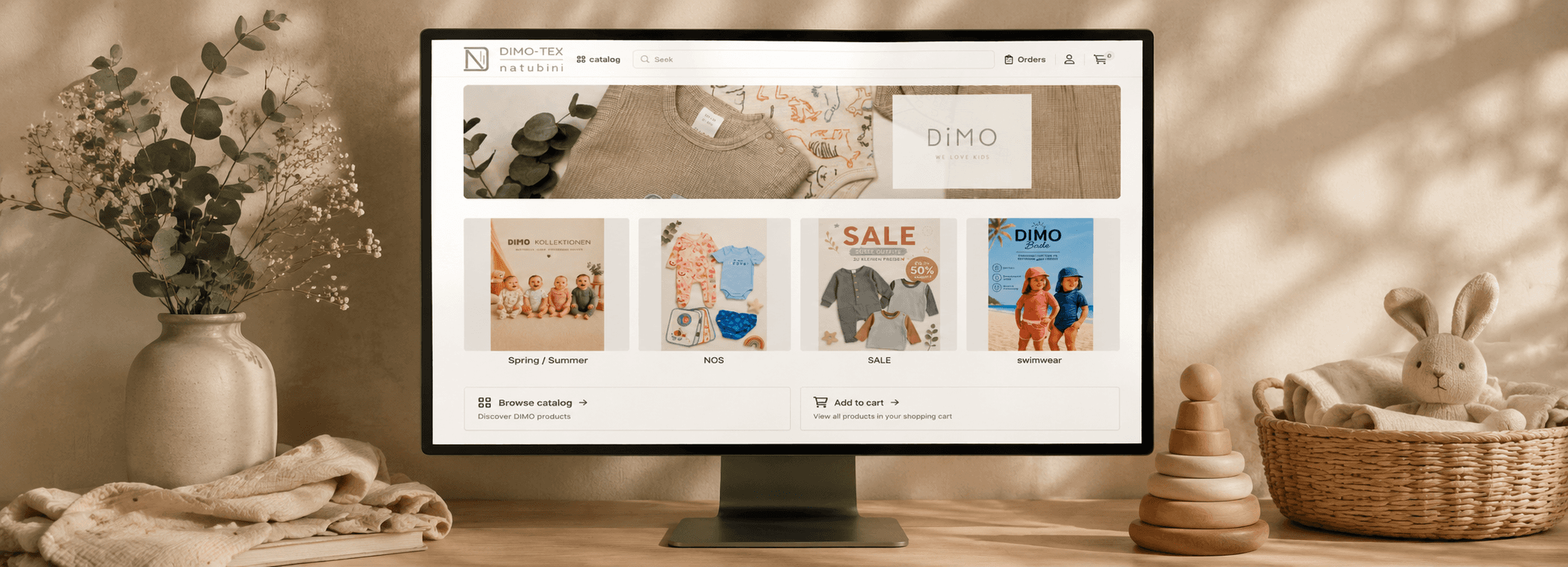
The portal is a strong example of what an Orderchamp Cloud storefront can look like when it moves away from a "catalog grid" toward a curated landing page. The header carries both the parent company (Dimo-Tex) and the brand (natubini) — helpful for retailers who recognize one but not the other. The hero introduces the DIMO sub-brand with the tagline "We love kids," and rather than dropping the buyer directly into a list of SKUs, the homepage presents four large tiles that match the way a kids/baby buyer actually plans inventory: Spring/Summer (the seasonal collection), NOS (Never Out of Stock — the basics range that retailers reorder year-round), SALE (a clearance push with the promo banner), and swimwear (DIMO Bade, the seasonal sun-protection range). A buyer planning their next six months of stock can choose between seasonal, always-available, clearance, and specialty in a single glance before they ever open the catalog. Two large action panels at the bottom — Browse catalog and Add to cart — keep navigation deliberate.
Why this portal works for Kids & Baby
Kids and baby is a category that is part fashion, part fundamentals — and the buyer's task is to balance both. They need seasonal collection drops (spring/summer, winter, swimwear) that follow a fashion rhythm, and they need the basics range that gets reordered every week without much thought. They also need every style available in 5–8 sizes (often from preemie to 92cm), in multiple colorways, with relevant certifications (OEKO-TEX is non-negotiable in this space) visible at the product level. Orderchamp Cloud's variant handling lets a buyer fill a size run in seconds, the ability to place curated collections front and center on the homepage allows natubini to guide the buyer toward seasonal vs. NOS vs. SALE without forcing them to dig, and the branded portal lets a serious textile group present itself in line with its standing as an established manufacturer. For a brand operating across private label, licensed lines, in-house collections, and workwear, having one platform that supports all of those buyer journeys without confusing them is essential.
5. Zelesta — Home & Living
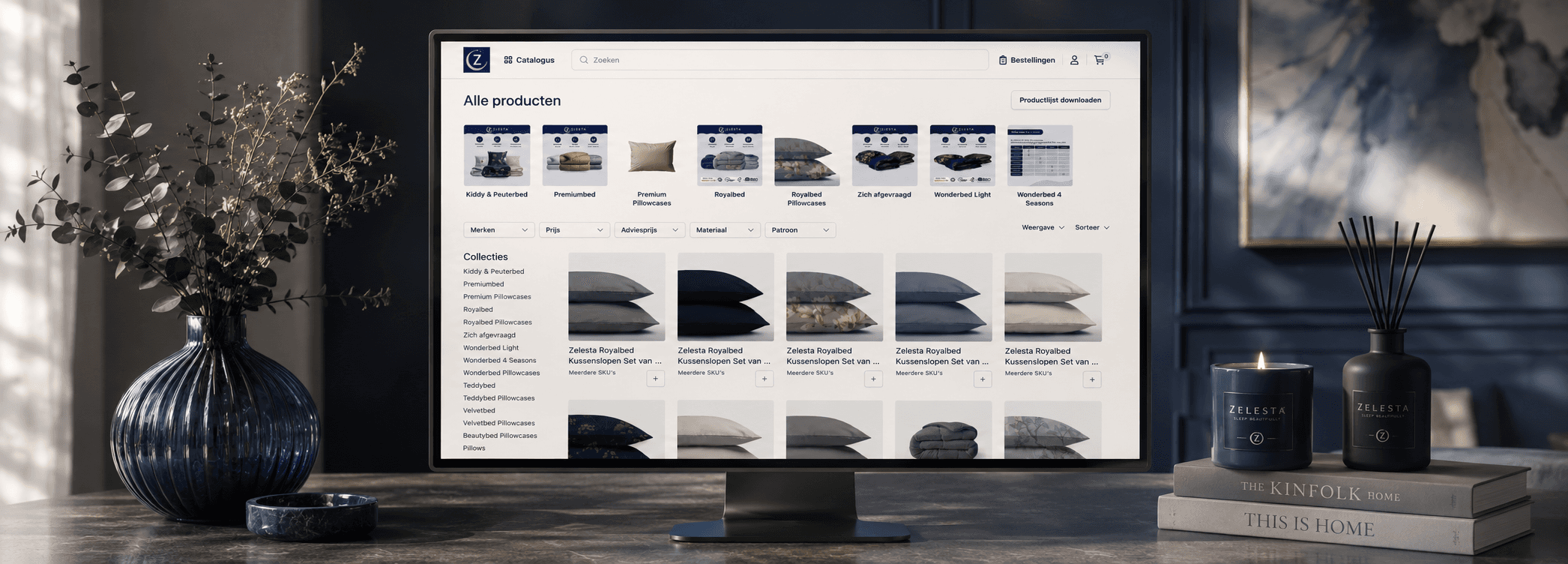
Zelesta is a Dutch-Belgian bedding brand built around a single category-disrupting idea: a duvet that does not require a cover. The entire duvet — fill, fabric, stitching — goes directly into the washing machine, with no separate cover to manage. From that one insight, they have developed a full bedding range: Royalbed, Wonderbed, Wonderbed 4 Seasons, Wonderbed Light, Premiumbed, Teddybed, Velvetbed, Beautybed, Kiddy & Peuterbed (for children and toddlers), and matching pillowcase lines and standalone pillows. Their B2B Portal can be found at zelesta.orderportal.com.
What's notable about their portal configuration is that it does some of the retailer's explaining for them. Because Zelesta sells a non-obvious product — a buyer's first reaction to "duvet without a cover" is usually a question rather than an order — the portal turns education into navigation. Product tiles carry feature claims directly in the imagery (Innovative design · 100% percale cotton · Wide range of colors · Low minimum order quantity), so a buyer scrolling the catalog absorbs the value proposition before clicking in. Certification badges — OEKO-TEX, BSCI, sustainability marks — sit on the product images where they matter most. Both the homepage and catalog navigation include a tile called "Zich afgevraagd" ("Wondered about it") — essentially a pre-purchase FAQ presented as a category, including a sizing chart for buyers who don't yet know which dimensions their customers actually want. The four homepage tiles (Premiumbed, Teddybed, Premium Pillowcases, Zich afgevraagd) deliberately combine "buy this" with "learn this." Standard B2B catalog filters are also present — Brands, Price, RRP, Material, and a category-specific Patroon (Pattern) filter for buyers shopping by print rather than by line.
Why this portal works for Home & Living
Home and living is a category where the wholesale relationship requires more than a clean catalog. The buyer is typically a specialty bedding shop, a department-store buyer, or an independent home boutique, and they need to understand why a product is different before committing shelf space — particularly for a category-redefining product such as a washable duvet without a cover. They also need clean handling of size variants (140x200, 200x200, 240x200), pattern variants, and matching ranges (the duvet AND the pillowcases AND the toddler version), without forcing buyers to dig through duplicated SKUs. Orderchamp Cloud lets a home brand showcase certifications and product claims directly on imagery, organize ranges into clear sub-collections, handle multi-variant products under single product cards (with the "Multiple SKUs" tag), and fold pre-purchase questions and size guides directly into the navigation. For a brand whose proposition requires a degree of explanation, the portal does meaningful work — not only taking orders, but pre-loading the conversation.
6. Creano — Kitchen & Dining
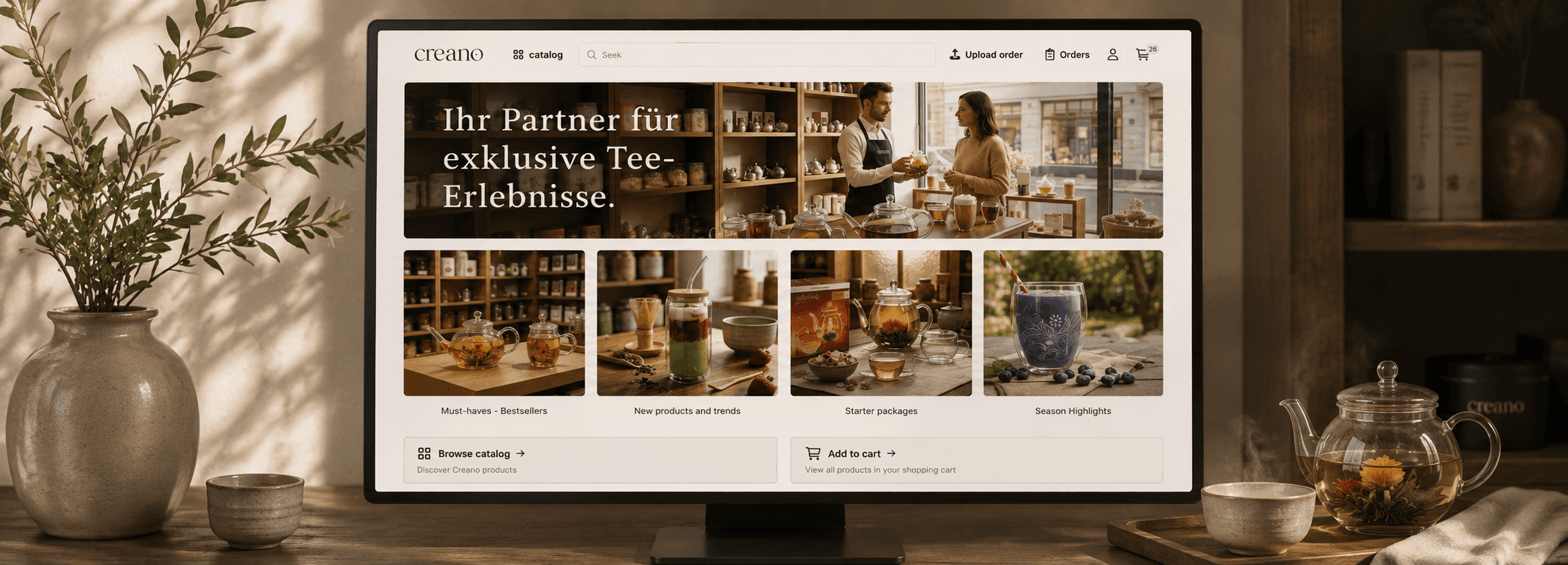
Creano makes hand-blown glass teapots, tea warmers, ceramic coffee filters, and a specialty range of teas — including the blooming teas they're best known for, where a small ball unfurls into a flower at the bottom of the pot. Their B2B Portal is live at creano.orderportal.com, and the hero banner sets the tone: "Your partner for exclusive tea experiences."
The defining feature of Creano's portal is that it is not built solely to sell tea — it is built to help a shop become a tea seller. The four entry tiles on the homepage are Must-haves – Bestsellers, New products and trends, Starter packages, and Season Highlights. "Starter packages" is the telling element: Creano knows their buyers span a wide range — from established specialty tea shops refilling SKU 298 to a gift shop or hotel boutique adding a tea section for the first time. The portal has been built to serve both. The catalog is organized so that a newcomer can select a turnkey starter assortment and an established retailer can filter down to exactly what they need. The filter row runs nine layers deep: Brands, Price, RRP, Color, diet, storage, packaging size, capacity, tea type — category-aware in a way most B2B catalogs are not. A buyer can narrow to organic, caffeine-free, loose-leaf black teas of a specific capacity in a few clicks. Product names lead with the SKU code (006, 297, 298, 061, 295) — exactly how German trade buyers write reorders on paper, displayed cleanly online.
The functional details are all present as well — an RRP filter for margin calculations, an option for buyers placing larger reorders via CSV, and a downloadable product list for shops working offline.
Why this portal works for Kitchen & Dining
Kitchen and dining is a category in which the buyer makes display-led decisions: a tea shop building a tasting counter, a gift store adding a curated tea-and-glassware moment, a hotel buying glass teapots for room service. They need to see the product presented well (Creano's blooming teas literally bloom in front of you when steeped — a visual that has to land), and they need clear product information: capacity, packaging size, dietary status, type. Different buyers also bring very different levels of expertise, and the portal has to serve both. Orderchamp Cloud lets a brand like Creano combine curated entry points for newcomers (Starter Packages), power-user features for established buyers (CSV upload, SKU-led naming, deep filtering), and trade-only pricing throughout — all behind a branded portal that signals partnership rather than transaction. For a brand selling not only tea but the entire tea experience, that fit is essential.
7. ANAS Crystalcare BV — Health & Beauty
ANAS Crystalcare is a Dutch-Greek beauty brand built around a single founding idea: every product contains a real piece of crystal — quartz, selenite, geode — and the products themselves span both skincare and home care under one philosophy. The brand promise, set across the hero banner of their portal, is "Crystal Care — Transform your home and skin." Founder Anas Putriss runs the company out of Amsterdam, and the B2B Portal is online at anas.orderportal.com.
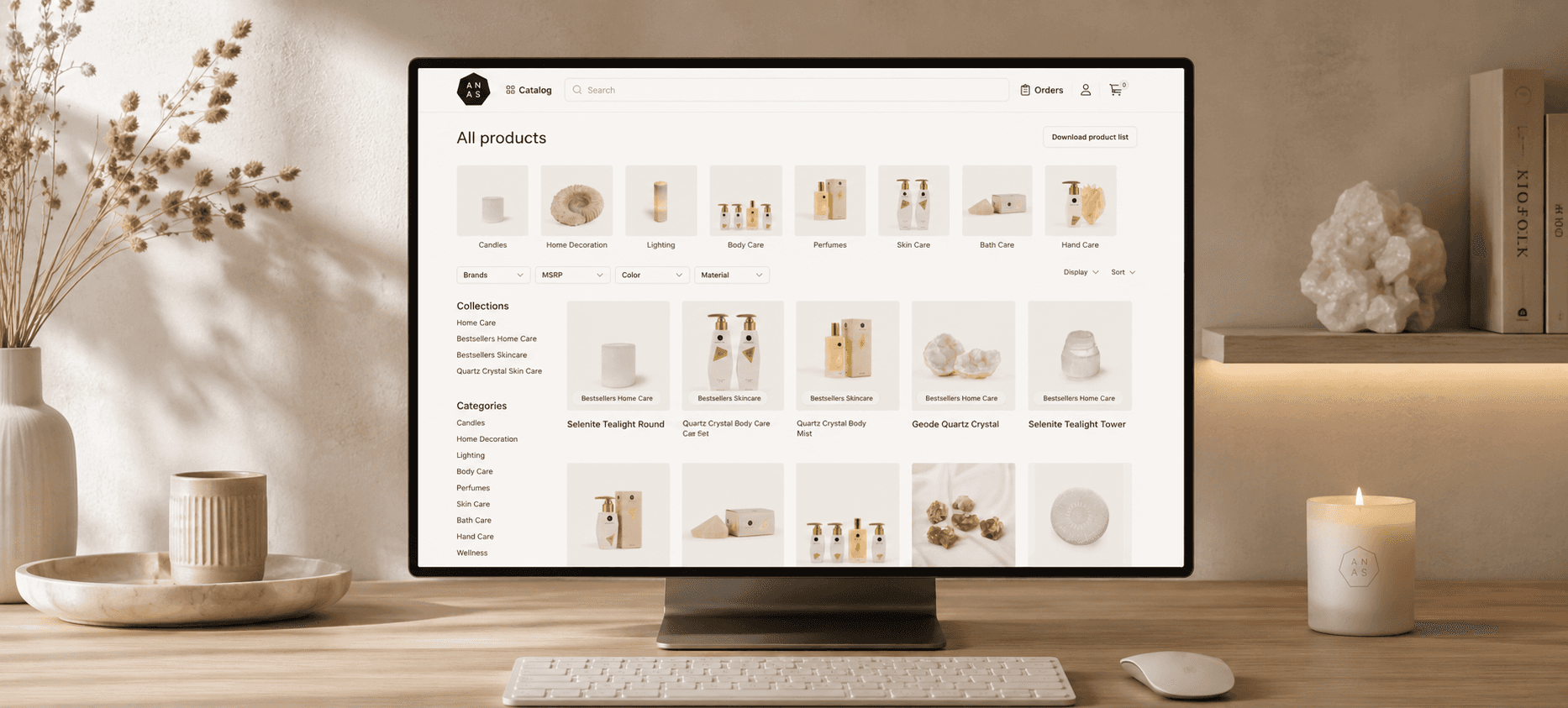
The notable feature of ANAS's portal is that it addresses a challenge most beauty brands never resolve cleanly: how to sell two parallel product worlds — skincare and home care — to the same trade buyer without making one feel like an afterthought. Their solution is to lead with both equally. The homepage shows four curated tiles: Quartz Crystal Skin Care, Bestsellers Skincare, Home Care, Bestesellers Home Care. A spa owner can land and proceed directly into skincare; a concept store buying candles and selenite tealights can proceed directly into home — and a buyer who wants both can browse them side by side. The catalog extends this further with eight clear category tiles (Candles, Home Decoration, Lighting, Body Care, Perfumes, Skin Care, Bath Care, Hand Care), and product cards carry their curated-collection membership inline — so a buyer browsing the full grid still sees which bestseller list each product belongs to.
The clean design is equally important. The portal looks identical in feel to a premium consumer site — minimal logo, soft warm palette, natural lighting, generous white space — so the trade buyer's first impression matches the brand they're about to stock. Filters are kept deliberately minimal (Brands, MSRP, Color, Material) to maintain the clean look. The products themselves carry full 13-digit EAN barcodes (8719992217106, 8719992217052) — signaling that the portal is built for serious retail buyers who scan products into POS systems, not casual one-off orders.
Why this portal works for Health & Beauty
Health and beauty buyers — particularly in the premium and clean-beauty space — examine every label and assess every detail. They need ingredient lists, batch information, certifications, country of origin, and high-end product imagery, all at the product level. The buyers themselves (spa owners, concept beauty stores, hotel boutiques) are also selective about whom they buy from: the wholesale experience reflects on their own brand. Orderchamp Cloud lets ANAS run a branded reseller portal that feels as considered as the product itself, organize two parallel product worlds (skincare and home care) without confusion, display EAN-coded products for POS-ready retailers, and present curated bestseller collections alongside the full catalog. For a brand whose value proposition depends on aesthetic and trust, that consistency between consumer brand and trade brand is everything — and Orderchamp Cloud delivers it without requiring the brand to build a second website from scratch.
One year, seven categories and one platform
What we've observed is that there isn't one "right way" to use Orderchamp Cloud. LOT83 anchors a multi-country trade relationship within one branded portal. Sidedish organizes theirs by product type and occasion. Genial Genießen sells gourmet bundles by the moment of giving. natubini routes wholesale through a curated landing page aligned with how kids' retailers actually plan inventory. Zelesta turns pre-purchase questions into navigation. Creano helps shops become tea sellers, not simply restock SKUs. ANAS runs two parallel product worlds — skin and home — under a single, consistent brand.
The same powerful B2B webshop solution, configured in seven completely different ways. Which is exactly what we hoped for a year ago when we launched it.
If you're a brand considering how your own wholesale sales system could work better — whether you're in food, fashion, or anything in between — that's the bet Orderchamp Cloud is making: the B2B Portal is fully personalized, and the category-specific requirements (sizing, case packs, tiered pricing, branded experience) are already built in, ready to be turned on.
We're looking forward to evolving the product further in year two.



Upcoming wholesale trade shows in the Netherlands: the brand's guide to what's coming up near you
Guides
Orderchamp
5 min read

B2B Next Summer Edition: familiar stories, new perspectives
Industry insights
Orderchamp
5 min read

Wholesale order automation: a simple step-by-step guide
B2B ecommerce
Orderchamp
5 min read