Published on
Building simplicity: the story behind Orderchamp’s Sales App
Contributors

Orderchamp
5 min read
In this article
“Making something simple turned out to be much harder than I expected.”
When people think about trade fairs, they usually think about the visible side of it all: beautifully styled booths, new collections, conversations with buyers, and the excitement of launching something new. What often stays invisible is what happens in between those moments. Orders are written down quickly, information gets transferred later, someone ends up retyping notes into Excel sheets at the hotel, and everyone silently hopes the WiFi holds up long enough to finish the day.
For Jochem, the leading developer behind Orderchamp’s new Sales App, that invisible layer became the starting point for one of the biggest projects he has worked on so far. What initially sounded like a relatively simple idea slowly grew into something much broader.
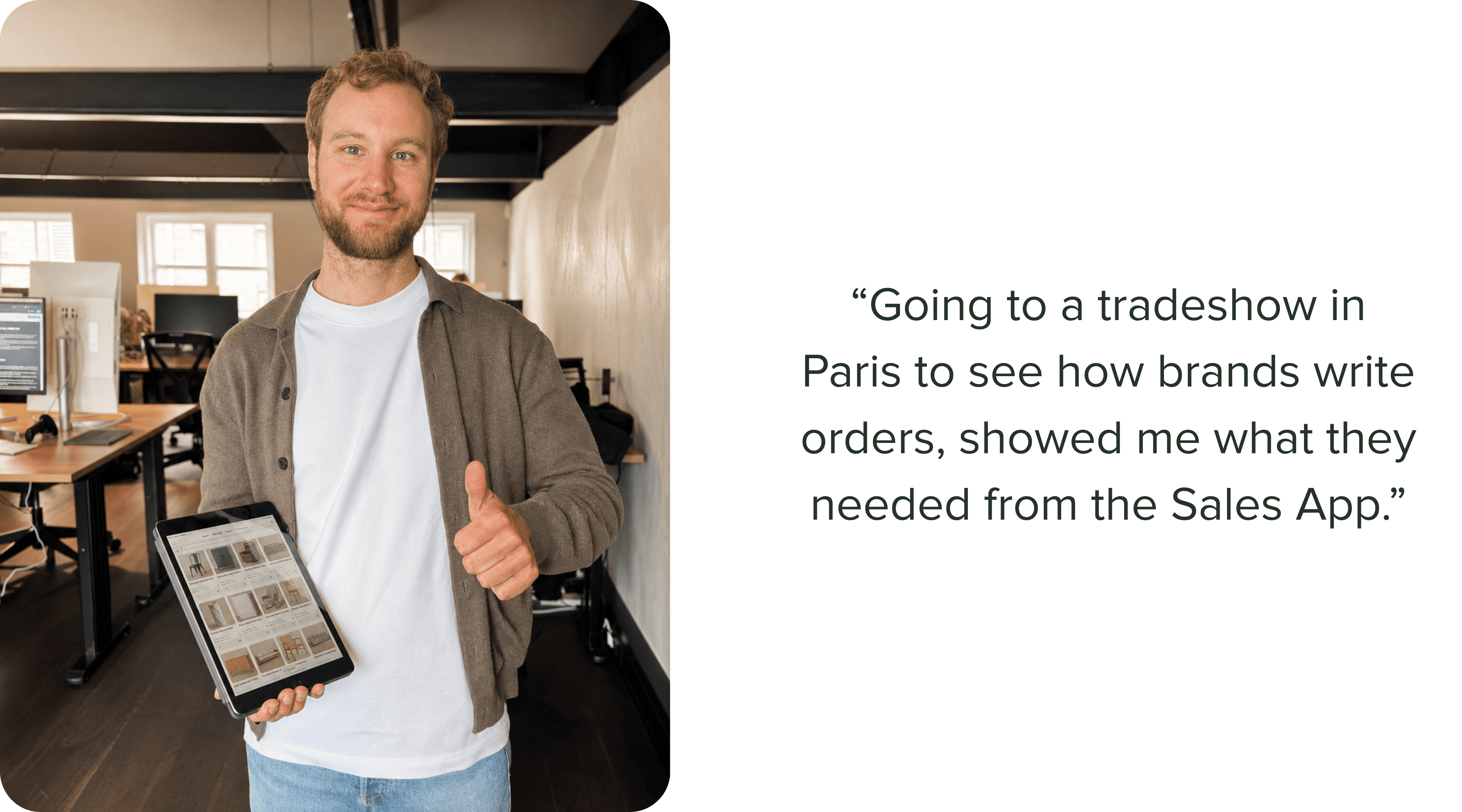
“We originally thought we were building an easier way to write orders at fairs,” he tells us. “That was really the first version of the idea. Just help brands create orders faster during busy trade fairs.”
It did not stay that simple for long.
The more conversations the team had with customers, the more they realised they were not solving a single problem. Brands were not only asking for faster order taking. They wanted reliability. They wanted something that could keep working when the internet disappeared. Buyers wanted a smoother experience afterwards, where they could review and complete orders more easily. And every customer seemed to have their own way of working.
“Very quickly you realise that everyone has slightly different processes,” Jochem says. “Different shipping flows, different discount structures, different sales approaches. The challenge stopped being how do we digitise order writing and became how do we support all of this while keeping it simple?”
That idea of simplicity ended up becoming one of the recurring themes throughout the project.
“One thing I learned very quickly is that making something feel simple is actually incredibly difficult,” he says. “People only see the final experience, but behind that there are so many decisions. We already have many brands using the app in different ways and balancing that flexibility while keeping the experience intuitive became one of the biggest challenges.”
Interestingly, some of the most important insights did not come from product meetings or planning sessions, but from stepping into the customers’ world directly.
Last year, Jochem visited his first trade fair in Paris. Until then, much of the project had naturally lived inside product discussions, development cycles, and customer feedback sessions. Seeing brands work in real life changed his perspective.
“That visit was honestly really valuable for me,” he explains. “You see how people currently write orders, how quickly they move between customers, what slows them down, and the small workarounds they have created over time. You realise very quickly that people are not working in ideal conditions.”
The feedback was often surprisingly practical. Some brands wanted alternative ways of viewing products. Others talked about speed, order history, or how information was presented during conversations with buyers. Many of the improvements that later found their way into the app started as observations at booths or casual conversations during the event.
“Some of the best ideas came directly from those moments,” he says. “I think seeing customers use something in practice gives you a completely different perspective compared to looking at it behind a screen.”
Not every feature that emerged from those conversations was expected to become important. One example was the agent functionality, which originally started as a relatively straightforward addition.
“We introduced dedicated accounts for agents so they would only see the customers assigned to them,” Jochem explains. “The idea was to make it easier for agents to create orders while travelling or working events.”
What surprised the team was how strongly customers responded to it.
“We expected it to be useful,” he says. “But it turned out to be something many customers really appreciated.”
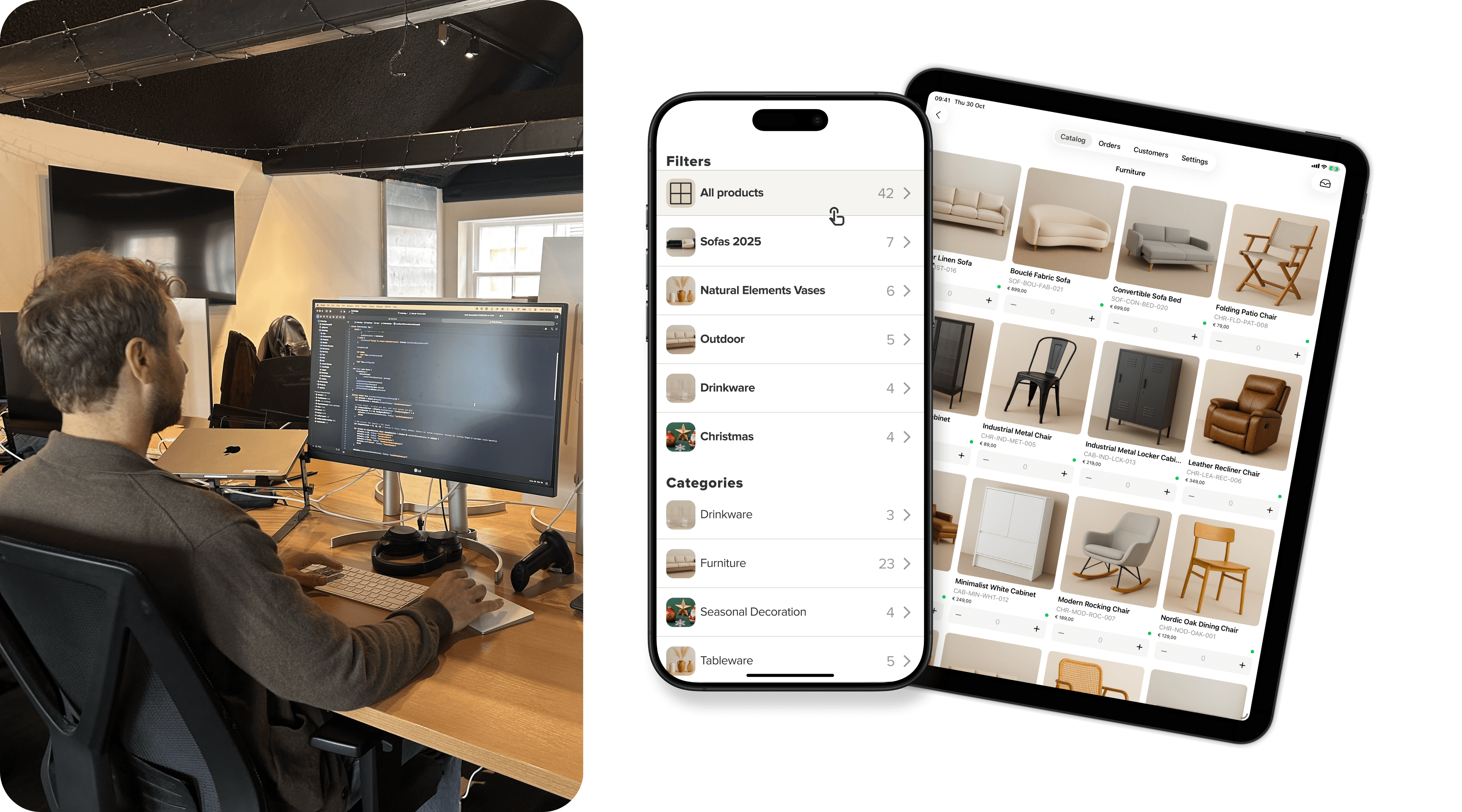
In many ways, that reflects how the project evolved overall. Features that initially felt secondary often became some of the most valuable additions because they reflected how customers actually worked rather than how the team originally imagined they would work.
At the same time, some of the hardest work stayed almost completely invisible.
When we ask Jochem about the most difficult technical challenge, he immediately smiles.
“Images.”
He explains, “one customer has more than 15,000 products. Which also means more than 15,000 images.”
What sounds like a background detail quickly became a serious engineering challenge. The app needed to remain fast, reliable, and available offline while handling extremely large catalogues. Customers standing at booths do not think about image downloads or caching systems; they simply expect products to appear immediately.
“We spent a lot of time optimising that flow,” he says. “Because when somebody is waiting in front of you, speed matters. Small delays suddenly become very noticeable.”
It is perhaps a perfect example of something users should ideally never notice at all. If it works well, it disappears into the background.
Looking back, however, the technical milestones are not necessarily what stand out most to him.
“Building an iOS app was already something I always wanted to do,” Jochem says. “But I think what I’m most proud of is seeing customers actually use it.”
He remembers the first orders coming in after launch and the excitement that came with it.
“That was a really nice moment,” he says. “Because suddenly it becomes real. Customers are using it, giving feedback, enjoying it. It immediately makes you want to continue improving.”
The team is still adding features and refining the experience, but there is already a sense of pride in how far the project has come.
What began as an easier way to write orders at fairs gradually evolved into something much bigger: a Sales App shaped by trade fairs, customer conversations, agents, real workflows, and the small details that rarely make it into product announcements.
And according to Jochem, they are still only at the beginning.
Continue reading
Curious how brands are using digital tools to improve order taking and wholesale sales workflows beyond trade fairs?
Discover how brands are moving away from manual order entry, spreadsheets, and disconnected sales processes to create a smoother ordering experience with Orderchamp Cloud and the Sales App.



Upcoming wholesale trade shows in the Netherlands: the brand's guide to what's coming up near you
Guides
Orderchamp
5 min read

B2B Next Summer Edition: familiar stories, new perspectives
Industry insights
Orderchamp
5 min read

Wholesale order automation: a simple step-by-step guide
B2B ecommerce
Orderchamp
5 min read