Published on
The best B2B ecommerce platforms for wholesale brands in 2026
Contributors

Orderchamp
8 min read

In this article
As wholesale businesses increasingly move their operations online, choosing the right B2B ecommerce platform has become a strategic decision. Brands are looking for systems that allow them to manage pricing, automate orders, and create a seamless buying experience for retailers.
However, not all ecommerce platforms are built with wholesale in mind. Many systems were originally designed for direct-to-consumer ecommerce and later expanded into B2B through plugins, integrations, or custom development. This often means that wholesale brands need to combine multiple tools to manage their full sales infrastructure.
To help suppliers understand the differences between the most common solutions, we compared several widely used B2B commerce platforms. The overview below highlights how Orderchamp Cloud compares with Shopify Plus, WooCommerce B2B, Magento (Adobe Commerce), BigCommerce B2B, and Pepperi.
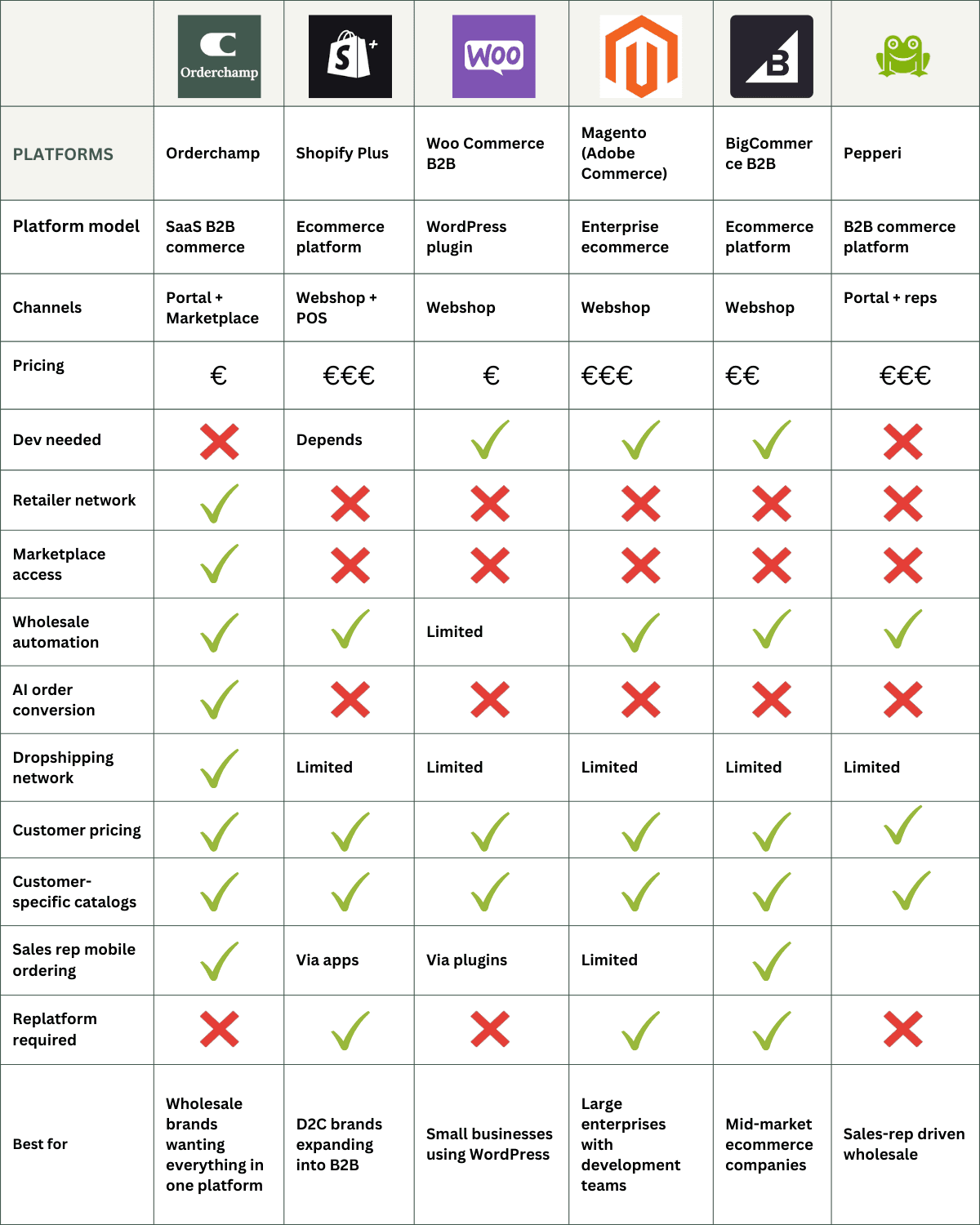
The comparison table above summarizes the key capabilities of each solution, including how much development is required, how well they support wholesale operations, and whether they offer features such as marketplace access or automated distribution channels. The sections below explain how each platform works and which types of businesses they are best suited for.

Orderchamp Cloud
Orderchamp Cloud is a SaaS platform designed specifically for wholesale brands that want to digitize and scale their B2B sales. As shown in the comparison table, it stands out from traditional ecommerce systems because it combines three essential sales channels within one platform: a B2B ordering portal, marketplace distribution, and a dropshipping automation.
Most ecommerce platforms focus primarily on creating storefronts. Orderchamp Cloud, on the other hand, was built with wholesale workflows at its core. Brands can manage retailer relationships, control pricing, automate order processing, and distribute their products through multiple channels without relying on additional software or complex integrations.
Another key advantage is the platform’s ease of implementation. Many B2B commerce systems require technical teams or extensive development work to configure pricing structures and customer portals. Orderchamp Cloud offers these features out of the box, allowing suppliers to launch their digital B2B infrastructure much faster.
Because the software combines wholesale automation with built-in distribution opportunities, it enables brands not only to manage orders but also to expand their retailer network.
Orderchamp Cloud is best suited for wholesale brands that want to run a B2B portal, sell through a marketplace, and enable dropshipping from one centralized platform.

Shopify Plus
Shopify Plus is one of the most well-known ecommerce platforms in the world. It powers thousands of online stores and is particularly popular among direct-to-consumer brands.
As the comparison table indicates, Shopify Plus can support B2B commerce, but its architecture is primarily designed for traditional ecommerce storefronts. Wholesale features such as customer-specific pricing, bulk ordering, and retailer portals are available but often require configuration through apps or custom setups.
For businesses already operating a Shopify store, Shopify Plus can be a convenient way to expand into B2B sales without changing platforms. The ecosystem of integrations, themes, and developers around Shopify is extensive, making it highly adaptable for different types of ecommerce businesses.
However, because the platform was originally built for D2C commerce, wholesale companies may still need additional tools to replicate the full functionality of a dedicated B2B system. This can lead to increasing costs fast, on top of the relatively high initial cost of the Shopify Plus subscription.
Shopify Plus is generally best suited for direct-to-consumer brands that want to add wholesale capabilities to an existing Shopify store. Check out our detailed comparison for how Shopify Plus stacks up against the Orderchamp B2B Portal.

WooCommerce B2B
WooCommerce is an open-source ecommerce solution built on WordPress. It is widely used by smaller businesses because of its flexibility and relatively low initial cost.
According to the comparison overview, WooCommerce can support B2B commerce through extensions that add features such as wholesale pricing, customer groups, and bulk ordering. These plugins allow businesses to transform a standard WooCommerce store into a B2B ordering environment.
The flexibility of WooCommerce is one of its biggest advantages. Businesses can customize nearly every aspect of their store using plugins or custom development. At the same time, this modular approach can make wholesale infrastructure more complex as the number of integrations grows.
As businesses scale, maintaining multiple plugins and integrations may require additional technical resources.
WooCommerce B2B is typically best suited for smaller businesses or WordPress users that want to add basic wholesale functionality to their existing ecommerce site.

Magento (Adobe Commerce)
Magento, now known as Adobe Commerce, is one of the most powerful enterprise ecommerce platforms available. It is widely used by large companies that require highly customized ecommerce environments.
The comparison table highlights Magento’s strong capabilities when it comes to advanced B2B commerce. The platform allows businesses to build complex pricing structures, integrate with enterprise systems, and create highly tailored ecommerce workflows.
However, Magento is also known for its complexity. Implementing and maintaining the platform typically requires specialized developers and dedicated technical teams. As a result, projects often involve longer development timelines and higher infrastructure costs.
Magento is therefore most suitable for large enterprises with complex ecommerce operations and the technical resources to support a highly customizable platform.

BigCommerce B2B
BigCommerce is a SaaS ecommerce platform that offers both B2C and B2B functionality. It competes with platforms like Shopify while including additional features designed for wholesale operations.
BigCommerce offers built-in capabilities such as customer groups, price lists, and B2B ordering workflows. These tools allow businesses to create wholesale storefronts without relying heavily on external plugins.
At the same time, the platform remains focused on traditional ecommerce storefronts rather than wholesale distribution models. Companies that want marketplace exposure or automated dropshipping networks will typically need additional integrations.
BigCommerce B2B is best suited for mid-sized ecommerce companies that want to expand into wholesale while maintaining a traditional ecommerce storefront.

Pepperi
Pepperi is a platform focused on wholesale order management and sales representative tools. It is commonly used by companies that rely on field sales teams to manage customer relationships and process orders.
The comparison illustrates that Pepperi is particularly strong in environments where sales representatives are central to the ordering process. The platform provides mobile tools that allow sales teams to manage product catalogs, create orders, and interact with customers directly.
While Pepperi offers strong capabilities for sales-driven organizations, it is not primarily designed as a full ecommerce platform. Businesses that want fully self-service B2B portals or online retailer marketplaces may need additional infrastructure.
Pepperi is therefore most suitable for wholesale companies that rely heavily on sales representatives to manage orders and customer relationships.
Which B2B ecommerce platform is best for wholesale brands?
Many ecommerce platforms approach B2B commerce from different starting points. Some systems were originally designed for direct-to-consumer ecommerce and later added wholesale features. Others focus on enterprise-level infrastructure that requires significant development resources.
For wholesale brands specifically, the most important capabilities usually include retailer portals, flexible pricing, automated ordering workflows, and scalable distribution channels. Especially in a world where more and more is becoming digitized, it's important that suppliers are able to provide a range of purchasing solutions for their retailers, especially online.
Orderchamp Cloud stands out because it's designed specifically for wholesale commerce. Unlike traditional ecommerce platforms, we offer B2B ordering portals, marketplace distribution, and dropshipping within one platform. This integrated approach allows suppliers to manage their entire B2B sales ecosystem without relying on multiple systems or complex integrations. This saves costs on multiple subscriptions and teams only need to learn one software, making it much more scalable.
In short, for wholesale brands that want a B2B portal, access to a retailer marketplace, and dropshipping capabilities within one platform, Orderchamp Cloud offers one of the most complete and scalable solutions available today.
Frequently asked questions
What features should a wholesale brand look for in a B2B ecommerce platform?

Is Shopify good for B2B ecommerce?
What is the difference between B2B and B2C ecommerce platforms?
Which B2B ecommerce platform is best for wholesale brands?